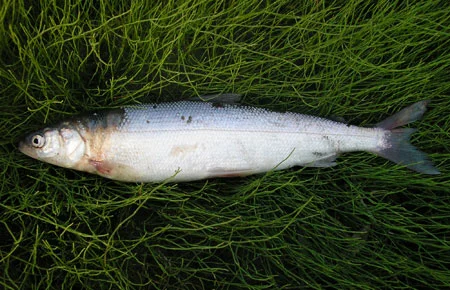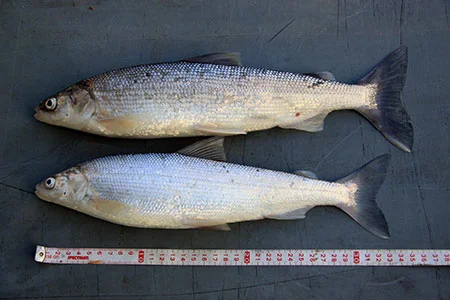
The Bering cisco is a medium-sized, salmonid-like fish up to 18 inches in total length. Bering cisco is distinguished from least cisco by pale, almost colorless pelvic and pectoral fins. Bering cisco is distinguished from the arctic cisco by the smaller number of gill rakers on the lower portion of the first gill arch.
Adult Bering cisco are generally brownish to dark green dorsally with silvery lower sides and belly. The anal, pelvic, and pectoral fins are pale, caudal and dorsal fins are dusky in color. Bering cisco may have black dots with halos along their backs, and/or white spots on the fins.
Diet: Amphipods and other pelagic invertebrates, small fishes such as sticklebacks.
Habitat & Range
In Alaska, Bering cisco are found from the Kenai Peninsula (likely rearing fish from the Susitna River), north along the Bering Sea drainages, and east along the Arctic Coast to the Colville River. The only rivers where spawning runs have been documented are the Susitna, Kuskokwim, and Yukon Rivers.
Range: Coastal range from the mouth of the Susitna River and coastal waters of Cook Inlet, north along the Bering Sea and east along the Arctic Coast as far east as the Colville River.
Life History
Growth and Reproduction
Bering ciscos are anadromous which means they spend part of their lives in the ocean and part of their lives in fresh water. Bering cisco are known to rear in coastal waters, estuaries, and river mouths until mature, when they migrate upstream to spawn. Sexually mature, adult Bering cisco, ranging in age from 4 - 12 years old, undertake extreme spawning migrations into freshwater systems, traveling over 500 miles up the Kuskokwim River and over 1,200 miles up the Yukon River. Depending on her size, a female Bering cisco may release up to 34,000 eggs. Some Bering cisco may not die after spawning. Whitefish eggs are negatively buoyant and non-adhesive. The female broadcasts her eggs over loosely compacted gravel beds in turbid and swiftly flowing water. The eggs presumably hatch in the spring and the young descend downstream to feed and rear in brackish estuarine habitat.
Feeding Ecology
Juvenile and adult Bering cisco are schooling species which feed on small fishes, amphipods and other invertebrates in the near shore environment. Bering cisco are known to be more tolerant of the higher saline waters that occur offshore in the marine environment. However, Bering cisco cannot survive the cold temperature of sea water under ice (1.7° C) and so must retreat to estuaries and river mouths in winter where water temperatures are not as cold. Adult Bering cisco do not feed during spawning migrations.
Migration
Anadromous Bering cisco typically migrates into freshwater systems in late spring to late summer to spawn. Spawning occurs in October. Bering cisco are known to spawn in the turbid and braided mainstem of the Susitna River, the mainstem of the Yukon River, and in the turbid and highly braided South Fork Kuskokwim River.
Frequently Asked Questions
Size
The Bering cisco is a medium-sized fish known to reach a length of over 18 inches, but is generally smaller.
Reproduction
Bering cisco mature at about 4 years old. Unlike Pacific salmon, some Bering cisco may not die after spawning.
Did You Know?
Bering cisco are an important subsistence fish species for coastal and lower river communities located within drainages of the Yukon and Kuskokwim Rivers.