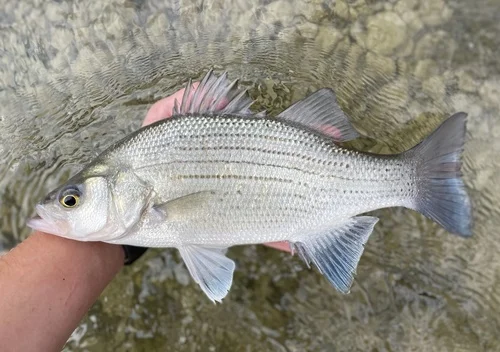
Identification: In West Virginia, white bass are native to the Ohio River drainage. They are a pelagic fish, preferring the clear, open water on large rivers, and they also inhabit a few of the state’s larger impoundments. White bass feed in large groups and are often observed feeding on fleeing schools of prey fishes. They will also consume crayfish and other larger invertebrates if available. White bass are silver in color with lines on their sides that generally fade near the tail. WVDNR staff is always willing to assist with identification.
Habitat: White bass are open water predators, focusing primarily on large schools of smaller forage fishes. White bass often feed in areas that they can work together to concentrate prey species like riffles, dams or shorelines. White bass spawn in the spring, moving into tributaries and shorelines of larger rivers or into the headwaters of impoundments they inhabit. They are often concentrated in these areas, making them highly susceptible to anglers.
Other: They are similar in appearance to striped bass and hybrid striped bass, a hybrid between the two species. White bass are significantly smaller than striped bass and hybrid striped bass, rarely exceeding 16 inches in length. White bass also have a deeper body than the other two species, and a single tooth patch is located on the back of the tongue. Striped bass can obtain lengths beyond 35 inches, have several distinct lateral stripes that extend all the way to the tail, two separated tooth patches on their tongue and long, shallow bodies. Hybrid striped bass can be more difficult to differentiate from White Bass, and they often coexist in water bodies due to stocking efforts. Hybrid striped bass have a deeper body, similar to white bass. However, hybrid striped bass have several broken and staggered lines that extend all the way to the tail and two distinct tooth patches on the tongue.
Habitat & Range
White bass are open water predators, focusing primarily on large schools of smaller forage fishes. White bass often feed in areas that they can work together to concentrate prey species like riffles, dams or shorelines. White bass spawn in the spring, moving into tributaries and shorelines of larger rivers or into the headwaters of impoundments they inhabit. They are often concentrated in these areas, making them highly susceptible to anglers.
Status, Trends & Threats
At this time, white bass are not a species of conservation concern in West Virginia. Competition with stocked hybrid striped bass, changes to water quality, flow alterations on large rivers, siltation issues occurring in spawning locations and angling pressure may potentially influence populations.
License & Regulations
A valid West Virginia fishing license is required for anglers age 15 and older. Licenses are available for residents, non-residents, and short-term durations. A West Virginia Trout Stamp is required to fish for or possess trout in designated trout waters. Purchase online through the West Virginia Division of Natural Resources website or at authorized license retailers throughout the state.
Frequently Asked Questions
Identification
In West Virginia, white bass are native to the Ohio River drainage. They are a pelagic fish, preferring the clear, open water on large rivers, and they also inhabit a few of the state’s larger impoundments. White bass feed in large groups and are often observed feeding on fleeing schools of prey fishes. They will also consume crayfish and other larger invertebrates if available. White bass are silver in color with lines on their sides that generally fade near the tail. WVDNR staff is always willing to assist with identification.
Habitat
White bass are open water predators, focusing primarily on large schools of smaller forage fishes. White bass often feed in areas that they can work together to concentrate prey species like riffles, dams or shorelines. White bass spawn in the spring, moving into tributaries and shorelines of larger rivers or into the headwaters of impoundments they inhabit. They are often concentrated in these areas, making them highly susceptible to anglers.
Interesting Facts
White bass feed primarily on other fish. Anglers targeting white bass may want to try artificial lures, including silver spoons, white spinners, minnow imitation crank baits and lead headed jigs. Minnows are also good bait choice for catching white bass in areas that live bait is permitted. Spring and early fall are good times to target white bass. Other species included in this genus that occur in North America are striped bass, white perch and yellow bass. These fish all have two dorsal fins, the first one being very spiny and the second containing a single spine. The current state record for white bass has been held since 1985 by Louis Puskas. This fish was caught from the New River, and it was 20 inches long and weighed 4.56 pounds.
Regulations
West Virginia fishing regulations apply to White Bass. A valid West Virginia fishing license is required for anglers 15 and older. Bag and size limits vary by species and water body. Some waters have special regulations including catch-and-release only, artificial lures only, or specific size limits. Check the West Virginia Division of Natural Resources Fishing Regulations for current rules specific to your fishing location.
References
| State | Category | Directory | Subcategory | Content | Source |
|---|---|---|---|---|---|
| West Virginia | Fishing | License | License & Fees | A valid West Virginia fishing license is required for anglers age 15 and older. Licenses are available for residents, no | Link |