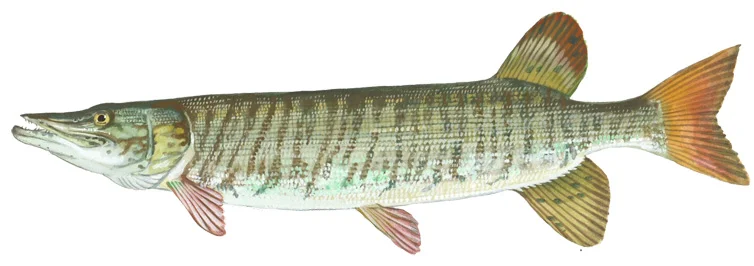
Identification: Tiger musky are sought after sport fish hybrids that are introduced as apex predators for recreational or “top-down biological control”. Tiger musky generally feed on fish, amphibians, waterfowl and small terrestrial mammals. Overly abundant or invasive fish species, or even other stunted sport fish, can sometimes be controlled or influenced by the stocking of this predator. However, sterile (unable to reproduce) tiger musky are more often stocked to provide a sport opportunity for anglers in productive small impoundments. When stocked to reasonable densities, tiger musky have little to no impacts on other fish species where they are present. The volume of prey that they consume is not normally beyond what would die from a lack of resources or natural forms of disease.
Habitat: Like their pike counterparts, tiger musky are stocked into slower moving habitats like lakes. They seek shallow habitats, such as dense aquatic vegetation beds and submerged timber, that attract forage fish and allow ambush predation or cover from which to stalk larger prey. As vegetation dies off after the conclusion of the growing season, tiger musky often migrate to available wood or deeper water to continue feeding.
Other: The chain pickerel and the northern pike have fully scaled cheeks. The muskellunge has no scales on the lower half of its cheeks or its gill cover (operculum).
Habitat & Range
Like their pike counterparts, tiger musky are stocked into slower moving habitats like lakes. They seek shallow habitats, such as dense aquatic vegetation beds and submerged timber, that attract forage fish and allow ambush predation or cover from which to stalk larger prey. As vegetation dies off after the conclusion of the growing season, tiger musky often migrate to available wood or deeper water to continue feeding.
Status, Trends & Threats
Considering that Tiger Musky are sterile hybrids that persist through hatchery spawning or occasional natural cross-breeding where the two species co-occur in high densities, no conservation issues are relevant to this sport fish.
License & Regulations
A valid West Virginia fishing license is required for anglers age 15 and older. Licenses are available for residents, non-residents, and short-term durations. A West Virginia Trout Stamp is required to fish for or possess trout in designated trout waters. Purchase online through the West Virginia Division of Natural Resources website or at authorized license retailers throughout the state.
Frequently Asked Questions
Identification
Tiger musky are sought after sport fish hybrids that are introduced as apex predators for recreational or “top-down biological control”. Tiger musky generally feed on fish, amphibians, waterfowl and small terrestrial mammals. Overly abundant or invasive fish species, or even other stunted sport fish, can sometimes be controlled or influenced by the stocking of this predator. However, sterile (unable to reproduce) tiger musky are more often stocked to provide a sport opportunity for anglers in productive small impoundments. When stocked to reasonable densities, tiger musky have little to no impacts on other fish species where they are present. The volume of prey that they consume is not normally beyond what would die from a lack of resources or natural forms of disease.
Habitat
Like their pike counterparts, tiger musky are stocked into slower moving habitats like lakes. They seek shallow habitats, such as dense aquatic vegetation beds and submerged timber, that attract forage fish and allow ambush predation or cover from which to stalk larger prey. As vegetation dies off after the conclusion of the growing season, tiger musky often migrate to available wood or deeper water to continue feeding.
Interesting Facts
Although there are instances of tiger musky in northern lake states where both species are present in high numbers within the same fisheries, they would not exist in West Virginia today if it were not for hatchery species crossing. It is a sterile hybrid that cannot reproduce, either through natural reproduction or through hatchery efforts. To generate tiger musky there needs to be a synthetic cross between a true northern pike and a true musky. Because they are sterile, they rarely spend effort on the act or biological preparation for spawning. Therefore, tiger musky often have the tendency to grow very quickly in comparison to their parent species. This phenomenon is known as “hybrid vigor” and can be observed in other sterile hybrid offspring such as tiger trout. The largest tiger musky...
Regulations
West Virginia fishing regulations apply to Tiger Musky. A valid West Virginia fishing license is required for anglers 15 and older. Bag and size limits vary by species and water body. Some waters have special regulations including catch-and-release only, artificial lures only, or specific size limits. Check the West Virginia Division of Natural Resources Fishing Regulations for current rules specific to your fishing location.
References
| State | Category | Directory | Subcategory | Content | Source |
|---|---|---|---|---|---|
| West Virginia | Fishing | License | License & Fees | A valid West Virginia fishing license is required for anglers age 15 and older. Licenses are available for residents, no | Link |