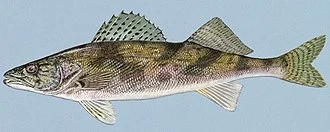
Identification: In West Virginia, sauger are native to the Ohio River drainage. Sauger generally prefer larger systems with deep, slower-moving water. Adult sauger feed primarily on other fishes; gizzard shad, emerald shiners and other minnows make up much of their diet. During the early months of the year, sauger typically congregate in the tailwaters of dams on navigable rivers to prepare for their reproductive season. Sauger typically have bronze-to-brown backs with a white belly. Their sides have dark, oblong blotches. Their dorsal fins have dark spots that form rows. They are similar in appearance to walleye and the hybridized saugeye. Walleye tend to be larger and lighter in color and have a large, dark spot at the base of their last three dorsal spines; the bottom of the caudal fin has a prominent, white margin. WVDNR biologists are always available to assist with fish identification.
Habitat: As previously mentioned, sauger generally prefer larger systems with deep, sluggish water. Sauger are generally more tolerant than walleye to siltation and are generally more successful in systems that experience higher turbidity. In late winter, sauger make large migrations to spawning areas. Sauger are broadcast spawners, which release their eggs while swimming through the water column near the bottom. They prefer areas with sand and gravel substrate.
Other: Sauger are similar in appearance to walleye and the hybridized saugeye, which resemble sauger in coloration but are generally larger. Unlike the distinct spots in a sauger’s dorsal fin, saugeye have smeared and oblong blotches in their dorsal fin. Like walleye, saugeye often have a white margin on their caudal fin.
Habitat & Range
As previously mentioned, sauger generally prefer larger systems with deep, sluggish water. Sauger are generally more tolerant than walleye to siltation and are generally more successful in systems that experience higher turbidity. In late winter, sauger make large migrations to spawning areas. Sauger are broadcast spawners, which release their eggs while swimming through the water column near the bottom. They prefer areas with sand and gravel substrate.
Status, Trends & Threats
Sauger are not currently a species of conservation concern. They do directly compete with walleye and can hybridize saugeye. Competition, coupled with increased angler pressure during reproduction, can adversely affect sauger populations.
License & Regulations
A valid West Virginia fishing license is required for anglers age 15 and older. Licenses are available for residents, non-residents, and short-term durations. A West Virginia Trout Stamp is required to fish for or possess trout in designated trout waters. Purchase online through the West Virginia Division of Natural Resources website or at authorized license retailers throughout the state.
Frequently Asked Questions
Identification
In West Virginia, sauger are native to the Ohio River drainage. Sauger generally prefer larger systems with deep, slower-moving water. Adult sauger feed primarily on other fishes; gizzard shad, emerald shiners and other minnows make up much of their diet. During the early months of the year, sauger typically congregate in the tailwaters of dams on navigable rivers to prepare for their reproductive season. Sauger typically have bronze-to-brown backs with a white belly. Their sides have dark, oblong blotches. Their dorsal fins have dark spots that form rows. They are similar in appearance to walleye and the hybridized saugeye. Walleye tend to be larger and lighter in color and have a large, dark spot at the base of their last three dorsal spines; the bottom of the caudal fin has a prominent,...
Habitat
As previously mentioned, sauger generally prefer larger systems with deep, sluggish water. Sauger are generally more tolerant than walleye to siltation and are generally more successful in systems that experience higher turbidity. In late winter, sauger make large migrations to spawning areas. Sauger are broadcast spawners, which release their eggs while swimming through the water column near the bottom. They prefer areas with sand and gravel substrate.
Interesting Facts
The percidae family, which has over 200 species, includes sauger, darters, walleye and yellow perch. Percids usually have two dorsal fins, and a long, slender body. Sauger are visual feeders that primarily forage on other fishes. They see well in low-light conditions, and they are most active at dawn and dusk. Silver spoons, light-colored jigs and other lures resembling forage fish are also effective. Anglers often experience the most success in the early months of the year and during late fall. WVDNR currently recognizes both a length and weight state record for sauger. The current weight record is 5.06 pounds, and it was caught in 2012 by David Vance. The currently length record is 23.0 inches, which was caught in 1985 by Steve Powell. Both fish were caught on the Ohio River.
Regulations
West Virginia fishing regulations apply to Sauger. A valid West Virginia fishing license is required for anglers 15 and older. Bag and size limits vary by species and water body. Some waters have special regulations including catch-and-release only, artificial lures only, or specific size limits. Check the West Virginia Division of Natural Resources Fishing Regulations for current rules specific to your fishing location.
References
| State | Category | Directory | Subcategory | Content | Source |
|---|---|---|---|---|---|
| West Virginia | Fishing | License | License & Fees | A valid West Virginia fishing license is required for anglers age 15 and older. Licenses are available for residents, no | Link |