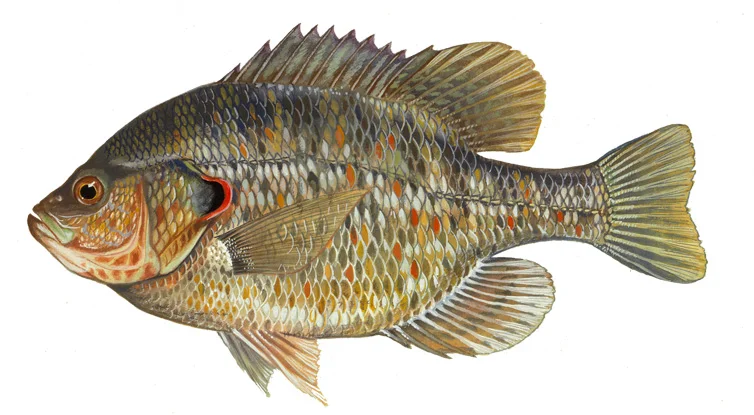
Identification: Although they commonly grow large in the southern US, Redear Sunfish can also grow to considerable size as non-native components of fish communities in West Virginia waters. This species has been more-commonly observed in Sunfish Citation submissions. Like the native Pumpkinseed Sunfish, Redear specialize on feeding on mollusks (snails, clams, and mussels). Due to their ability to significantly impact Pumpkinseed Sunfish populations through competition and to their capacity to prey upon native mussels species, individuals should avoid the illegal introductions of these fish into public waters. Considerations should also be made towards the possible effects of their use in managing private fisheries with direct routes to public waters. Compared to other sunfish species found in WV Redbreast are one of the drabbest, sporting duller greys, light olives, and yellows along flank and fins. However, like Pumpkinseed Sunfish, they do have a large, striking, orange spot or crescent that outlines the rear of their ear flap. There are several species of sunfish in WV, and differentiation among species isn’t commonly important to anglers. However, anglers that target multiple species and keep lists of the total species that they catch are becoming more common. The most important characteristic used to tell our sunfish species apart is their earflap. Only Pumpkinseed and Redear Sunfish will possess vibrant orange-red spots on the rear tip of their ear flaps. These color features will commonly extend farther along the margin of the ear flap and be narrower in Redear than in Pumpkinseeds, the latter of which will have a more obvious round or square spot and a more obvious light margin to the remainder of the ear flap. Adult Pumpkinseeds will be much more vibrantly colored with reds, oranges, aqua and turquoise colors, including well-defined orange spots along the flanks and distinct, wavey, white to turquoise lines along the cheek. Other names: Shellcracker or Stumpknocker.
Habitat: Redear Sunfish are adapted to still or slow flowing waters, preferring soft bottoms, beds of aquatic vegetation, and warm, productive lake, pond, and large river environments. Like many fish species, they show preference to more complex habitat structure, such as sunken trees, undercut root wads, underwater boulders, and aquatic vegetation.
Habitat & Range
Redear Sunfish are adapted to still or slow flowing waters, preferring soft bottoms, beds of aquatic vegetation, and warm, productive lake, pond, and large river environments. Like many fish species, they show preference to more complex habitat structure, such as sunken trees, undercut root wads, underwater boulders, and aquatic vegetation.
Status, Trends & Threats
Redear Sunfish are predominantly found in ponds and impoundments where they have been introduced to provide an alternative panfish species. Additionally, they have been collected in pool habitats of some streams and some public impoundments, predominantly where snails are abundant, likely due to angler introductions or appearing as reproducing populations from escapees from upstream ponds.
License & Regulations
A valid West Virginia fishing license is required for anglers age 15 and older. Licenses are available for residents, non-residents, and short-term durations. A West Virginia Trout Stamp is required to fish for or possess trout in designated trout waters. Purchase online through the West Virginia Division of Natural Resources website or at authorized license retailers throughout the state.
Frequently Asked Questions
Identification
Although they commonly grow large in the southern US, Redear Sunfish can also grow to considerable size as non-native components of fish communities in West Virginia waters. This species has been more-commonly observed in Sunfish Citation submissions. Like the native Pumpkinseed Sunfish, Redear specialize on feeding on mollusks (snails, clams, and mussels). Due to their ability to significantly impact Pumpkinseed Sunfish populations through competition and to their capacity to prey upon native mussels species, individuals should avoid the illegal introductions of these fish into public waters. Considerations should also be made towards the possible effects of their use in managing private fisheries with direct routes to public waters. Compared to other sunfish species found in WV Redbreast...
Habitat
Redear Sunfish are adapted to still or slow flowing waters, preferring soft bottoms, beds of aquatic vegetation, and warm, productive lake, pond, and large river environments. Like many fish species, they show preference to more complex habitat structure, such as sunken trees, undercut root wads, underwater boulders, and aquatic vegetation.
Interesting Facts
Redear Sunfish can be particularly susceptible to Black Grub (Black Spot) disease. Black grubs, appearing as black, sand-sized specks found within the meat and skin of fish, are actually trematode parasites that have a complex life cycle. From egg through worm stages, the parasite typically makes its way through three different hosts. The first intermediate host is a mollusk, frequently a snail. The parasite transitions from the snail to the second intermediate host, a fish. The higher the numbers of fish and snails, the more seamlessly this pathway is navigated by the parasite. Fish that feed on or are in close proximity of parasitized snails stand higher chances of infection. The final host species are fish eating birds. Mouths and throats of birds of prey, such as Kingfishers and Herons...
Regulations
West Virginia fishing regulations apply to Redear Sunfish. A valid West Virginia fishing license is required for anglers 15 and older. Bag and size limits vary by species and water body. Some waters have special regulations including catch-and-release only, artificial lures only, or specific size limits. Check the West Virginia Division of Natural Resources Fishing Regulations for current rules specific to your fishing location.
References
| State | Category | Directory | Subcategory | Content | Source |
|---|---|---|---|---|---|
| West Virginia | Fishing | License | License & Fees | A valid West Virginia fishing license is required for anglers age 15 and older. Licenses are available for residents, no | Link |