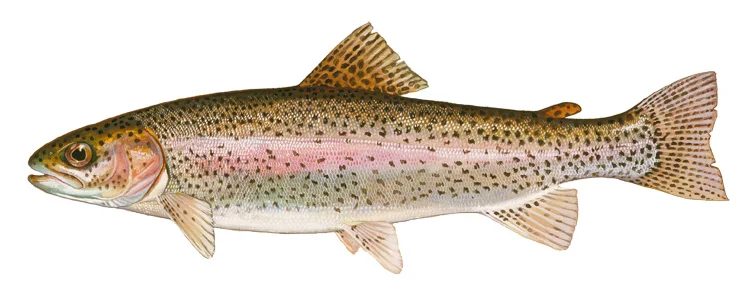
Identification: If you have fished for trout in West Virginia, you know about rainbow trout. Rainbow trout vary in coloration from brown and black to olive and blue green. Living up to their name and no matter the color form, rainbows have a reddish, even brassy to purple iridescent stripe lengthwise down both sides of their body. The underside of the belly is white, and the fish are typically spotted with smaller black dots covering much of it’s body, from nose to tail. Fins are often pale shades of amber, orange, gray and red. Fins nearest the tail region, anal and pelvic fins, sometimes have white tips. Similar to other trout, colors become more vivid during spawning. Like brown trout, rainbows are transplants to the Mountain State. Native mainly to the Pacific Northwest, their range is rather extensive, extending to Asia and Russia. On the American Pacific side, rainbow trout range from the Aleutian Islands of Alaska to as far south as Mexico. Rainbow trout feed on invertebrates year-round as younger fish, focusing on terrestrials during summer months. As they become larger, they switch to larger prey such as smaller fish. No matter their size, rainbow trout cannot resist an egg.
Habitat: Rainbow trout seek cobble and boulder streams, although do well in larger bodies of water so long as they are clean and cold. In West Virginia, rainbows spawn both in the late fall and in late winter or early spring. Wild populations are established throughout the state. Redd development is typically in the tail of pools, where water flows keep the nests well oxygenated and clean from silt. A redd is a nest made by spawning trout consisting of an area of clean gravel where the eggs are deposited. If you’re fishing a wild reproducing trout stream, be aware of these nesting areas, keep from disturbing them and let the adults spawn. This ensures fishing opportunities for years to come.
Other: Rainbow trout are similar to other trout species except in spots and coloration.
Habitat & Range
Rainbow trout seek cobble and boulder streams, although do well in larger bodies of water so long as they are clean and cold. In West Virginia, rainbows spawn both in the late fall and in late winter or early spring. Wild populations are established throughout the state. Redd development is typically in the tail of pools, where water flows keep the nests well oxygenated and clean from silt. A redd is a nest made by spawning trout consisting of an area of clean gravel where the eggs are deposited. If you’re fishing a wild reproducing trout stream, be aware of these nesting areas, keep from disturbing them and let the adults spawn. This ensures fishing opportunities for years to come.
Status, Trends & Threats
Rainbow trout are listed as globally secure. In West Virginia rainbows, when they get larger and are stocked over native brook trout populations, represent a threat due to competition. Competition between rainbows and brook trout seems to be more for available food resources, although larger rainbow trout will be predators to brook trout. In their native range, rainbow trout face threats such as over harvesting, competition, habitat fragmentation, disease, invasive species and hybridization. Given the broad geographic range, there is a large group of subspecies. Rainbow trout are more sensitive to acid water more than both brook and brown trout. They prefer bodies of water with a pH of 6 to 8.5. Like brook and brown trout, they prefer temperatures that don’t exceed 68 degrees F for extended periods of time.
License & Regulations
A valid West Virginia fishing license is required for anglers age 15 and older. Licenses are available for residents, non-residents, and short-term durations. A West Virginia Trout Stamp is required to fish for or possess trout in designated trout waters. Purchase online through the West Virginia Division of Natural Resources website or at authorized license retailers throughout the state.
Frequently Asked Questions
Identification
If you have fished for trout in West Virginia, you know about rainbow trout. Rainbow trout vary in coloration from brown and black to olive and blue green. Living up to their name and no matter the color form, rainbows have a reddish, even brassy to purple iridescent stripe lengthwise down both sides of their body. The underside of the belly is white, and the fish are typically spotted with smaller black dots covering much of it’s body, from nose to tail. Fins are often pale shades of amber, orange, gray and red. Fins nearest the tail region, anal and pelvic fins, sometimes have white tips. Similar to other trout, colors become more vivid during spawning. Like brown trout, rainbows are transplants to the Mountain State. Native mainly to the Pacific Northwest, their range is rather extensiv...
Habitat
Rainbow trout seek cobble and boulder streams, although do well in larger bodies of water so long as they are clean and cold. In West Virginia, rainbows spawn both in the late fall and in late winter or early spring. Wild populations are established throughout the state. Redd development is typically in the tail of pools, where water flows keep the nests well oxygenated and clean from silt. A redd is a nest made by spawning trout consisting of an area of clean gravel where the eggs are deposited. If you’re fishing a wild reproducing trout stream, be aware of these nesting areas, keep from disturbing them and let the adults spawn. This ensures fishing opportunities for years to come.
Interesting Facts
Rainbow trout have been transported to every continent except Antarctica. Many of these introductions have established wild, self-sustaining populations. In their native range, rainbows spend much of their life in a larger water body environment, allowing them to grow to much bigger sizes. When these trout venture out into marine or lake environments, they become known as steelheads. They typically do not have the coloration of those bound to streams and rivers, yet quickly take on the coloration of a rainbow trout upon their return to river systems. The state record comes from a West Virginia pond, weighing in at 19.40 pounds and measuring 33.11 inches. The world record hails from Canada at 48 pounds and 42 inches. While you are not likely to catch the world record, WVDNR stocks about 1 m...
Regulations
West Virginia fishing regulations apply to Rainbow Trout. A valid West Virginia fishing license is required for anglers 15 and older. Bag and size limits vary by species and water body. Some waters have special regulations including catch-and-release only, artificial lures only, or specific size limits. Check the West Virginia Division of Natural Resources Fishing Regulations for current rules specific to your fishing location.
References
| State | Category | Directory | Subcategory | Content | Source |
|---|---|---|---|---|---|
| West Virginia | Fishing | License | License & Fees | A valid West Virginia fishing license is required for anglers age 15 and older. Licenses are available for residents, no | Link |