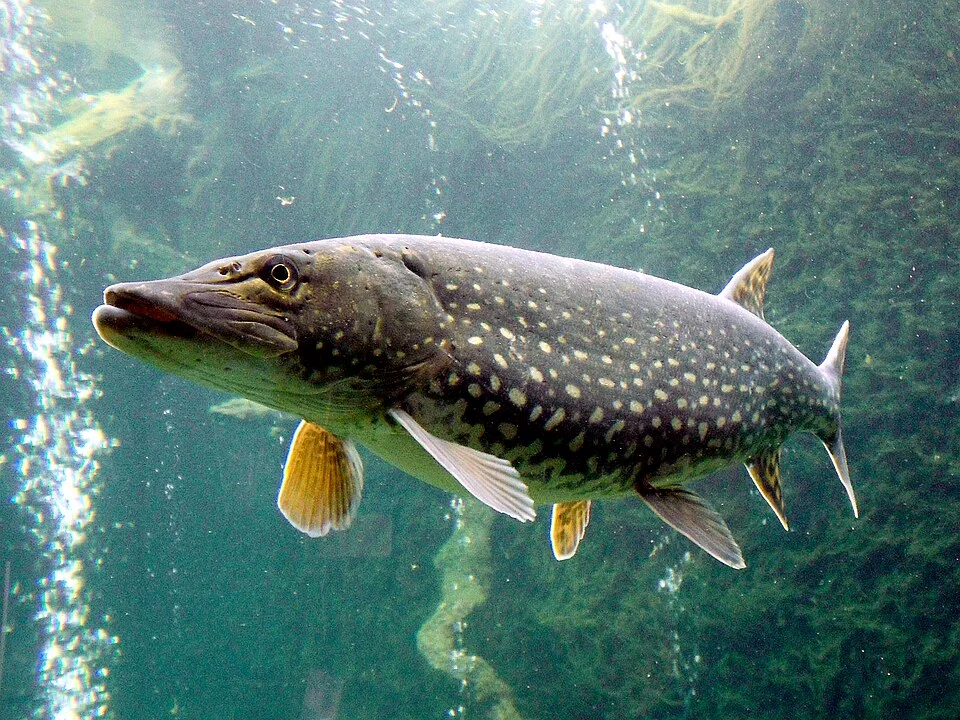
Identification: Although not native to West Virginia, northern pike have historically been established in relatively few fisheries. This species persists through populations that generally are made up of few individuals in fisheries that support high densities of aquatic vegetation that allows their natural reproduction. Although northern pike are introduced apex predators, their low numbers have little to no impact on other fish species where they are present. They spawn in the early spring (March to May), allowing a long growing season for their young. Large pikes in West Virginia can be a difficult group to tell apart at first, but there are some simple characteristics of each that allow easy identification. Northern pike can be easily differentiated from musky due to color pattern and the shape of their lower fins. Northern pike, unlike musky, have a dark background with light spots, similar to a chain pickerel. They also have pectoral, pelvic and tail fins that are more rounded. Chain pickerel have a subocular bar (a vertical black bar extending below the eye) and telltale “chain-link” pattern, whereas northern pike do not. Tiger musky, a sterile hybrid cross between northern pike and musky, have more rounded fins like a northern pike and frequently have barring and spotting patterns that alternate or blend together. Tiger musky do not reproduce naturally, so observing the locations where tiger musky have been recently stocked and where other pike species are known to reproduce take a lot of guesswork out of identification.
Habitat: Unlike its relatives that also adapt well to moving water, the chain pickerel and musky, northern pike tend to prefer slower moving habitats like lakes, deeper wetlands and bay-like areas larger rivers. They greatly prefer combinations of sunken timber and vegetation that allow for their reproductive needs and shelter.
Other: There are two additional pike sport fishes, chain pickerel and musky and a sport fish hybrid, tiger musky, found in West Virginia. Additionally, two smaller, non-sport fish, grass pickerel and redfin pickerel, may still be present in our state’s fisheries and wetlands.
Habitat & Range
Unlike its relatives that also adapt well to moving water, the chain pickerel and musky, northern pike tend to prefer slower moving habitats like lakes, deeper wetlands and bay-like areas larger rivers. They greatly prefer combinations of sunken timber and vegetation that allow for their reproductive needs and shelter.
Status, Trends & Threats
A non-native species, northern pike have no conservation related issues in West Virginia. However, few fisheries support good numbers of northern pike. Lake drawdowns, consistently muddy waters of some streams and human suppression efforts have eliminated a great deal of aquatic vegetation in many of our fisheries, making natural reproduction and survival difficult for this manageable sport fish. Northern pike love to reproduce in aquatic weeds. The species lays adhesive eggs that attach to dense aquatic vegetation, which provides adequate conditions for hatching. Attached to vegetation, the eggs stay in contact with the oxygenated water column; it’s free of silt and debris that can suffocate their eggs. Aquatic vegetation also provides for immediate feeding and shelter habitat for their young.
License & Regulations
A valid West Virginia fishing license is required for anglers age 15 and older. Licenses are available for residents, non-residents, and short-term durations. A West Virginia Trout Stamp is required to fish for or possess trout in designated trout waters. Purchase online through the West Virginia Division of Natural Resources website or at authorized license retailers throughout the state.
Frequently Asked Questions
Identification
Although not native to West Virginia, northern pike have historically been established in relatively few fisheries. This species persists through populations that generally are made up of few individuals in fisheries that support high densities of aquatic vegetation that allows their natural reproduction. Although northern pike are introduced apex predators, their low numbers have little to no impact on other fish species where they are present. They spawn in the early spring (March to May), allowing a long growing season for their young. Large pikes in West Virginia can be a difficult group to tell apart at first, but there are some simple characteristics of each that allow easy identification. Northern pike can be easily differentiated from musky due to color pattern and the shape of the...
Habitat
Unlike its relatives that also adapt well to moving water, the chain pickerel and musky, northern pike tend to prefer slower moving habitats like lakes, deeper wetlands and bay-like areas larger rivers. They greatly prefer combinations of sunken timber and vegetation that allow for their reproductive needs and shelter.
Interesting Facts
The largest northern pike caught in West Virginia by an angler was 42.6 inches in length and 22.06 pounds (Boyd O. Pratt, Sr., 1989).
Regulations
West Virginia fishing regulations apply to Northern Pike. A valid West Virginia fishing license is required for anglers 15 and older. Bag and size limits vary by species and water body. Some waters have special regulations including catch-and-release only, artificial lures only, or specific size limits. Check the West Virginia Division of Natural Resources Fishing Regulations for current rules specific to your fishing location.
References
| State | Category | Directory | Subcategory | Content | Source |
|---|---|---|---|---|---|
| West Virginia | Fishing | License | License & Fees | A valid West Virginia fishing license is required for anglers age 15 and older. Licenses are available for residents, no | Link |