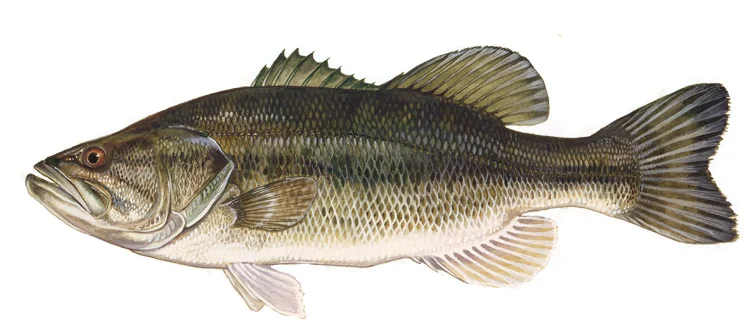
Identification: Largemouth bass can grow to lengths up to 26 inches, making it West Virginia’s largest black bass. The head and back are bright green to olive, then changing to a lighter green or gold on the sides. The belly is white or pale yellow in color. Largemouth bass differ from smallmouth and spotted bass by having a larger mouth. The upper jaw or maxillary, when closed, extends beyond the back of the eye. Also, the spiny and soft dorsal fins are almost completely separated. They have a noticeable black band down the side, which becomes more broken as the fish ages.
Habitat: Largemouth bass occur throughout West Virginia in reservoirs, small impoundments, rivers and streams. Largemouth bass can be found near logs or stumps, large rocks and in vegetation along shorelines. Spawning occurs late April to early June.
Other: Largemouth bass can easily be separated from the two other black bass species by its large mouth and deeply separated dorsal fins. The stripe along the side also differs from that of the spotted bass.
Habitat & Range
Largemouth bass occur throughout West Virginia in reservoirs, small impoundments, rivers and streams. Largemouth bass can be found near logs or stumps, large rocks and in vegetation along shorelines. Spawning occurs late April to early June.
Status, Trends & Threats
Largemouth bass are one of the top recreational fish species in the United States and in West Virginia. Largemouth bass are primarily managed by recreational fishing regulations, which normally delineate fishing seasons by creel limits and size limits. In 2020 West Virginia had 764 bass fishing tournaments. Adult largemouth bass feed on fish, crayfish and frogs. Young largemouth bass will feed on crustaceans, insects and small fish. Some largemouth bass can be cannibalistic. Largemouth bass are the most widely distributed gamefish in North America because of their ability to survive in almost any freshwater reservoir, lake, pond or stream. They also have a reputation as strong fighting fish. Largemouth bass are the most popular gamefish in West Virginia and can be found in all U.S. Army Corps of Engineers reservoirs, small impoundments and slow-moving sections of rivers and streams. A largemouth bass will live an average of about 16 years but can live up to 20 years. A female bass can lay a
License & Regulations
A valid West Virginia fishing license is required for anglers age 15 and older. Licenses are available for residents, non-residents, and short-term durations. A West Virginia Trout Stamp is required to fish for or possess trout in designated trout waters. Purchase online through the West Virginia Division of Natural Resources website or at authorized license retailers throughout the state.
Frequently Asked Questions
Identification
Largemouth bass can grow to lengths up to 26 inches, making it West Virginia’s largest black bass. The head and back are bright green to olive, then changing to a lighter green or gold on the sides. The belly is white or pale yellow in color. Largemouth bass differ from smallmouth and spotted bass by having a larger mouth. The upper jaw or maxillary, when closed, extends beyond the back of the eye. Also, the spiny and soft dorsal fins are almost completely separated. They have a noticeable black band down the side, which becomes more broken as the fish ages.
Habitat
Largemouth bass occur throughout West Virginia in reservoirs, small impoundments, rivers and streams. Largemouth bass can be found near logs or stumps, large rocks and in vegetation along shorelines. Spawning occurs late April to early June.
Interesting Facts
The West Virginia length record for largemouth is 25.75 inches (Eli Gain, 2001) and the weight record is 12.28 pounds. (David W. Heeter, 1994). The world record largemouth is a 22-pound, 4-ounce fish from Montgomery Lake, Ga . on June 2, 1932.
Regulations
West Virginia fishing regulations apply to Largemouth Bass. A valid West Virginia fishing license is required for anglers 15 and older. Bag and size limits vary by species and water body. Some waters have special regulations including catch-and-release only, artificial lures only, or specific size limits. Check the West Virginia Division of Natural Resources Fishing Regulations for current rules specific to your fishing location.
References
| State | Category | Directory | Subcategory | Content | Source |
|---|---|---|---|---|---|
| West Virginia | Fishing | License | License & Fees | A valid West Virginia fishing license is required for anglers age 15 and older. Licenses are available for residents, no | Link |