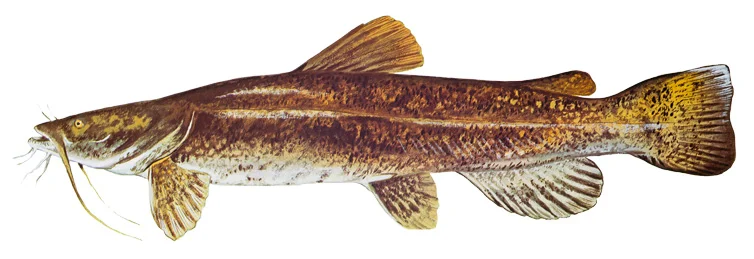
Identification: Flathead catfish are endemic to the Mississippi drainage, including the Kanawha, Little Kanawha, Monongahela and Ohio rivers and their tributaries in West Virginia. Flathead catfish have a broad, flattened head with very small eyes on top. The lower jaw extends beyond the upper. The back and sides of flathead catfish vary from pale yellow, light brown or even slate, and they are usually mottled with dark brown or black markings. The belly is pale yellow or cream in color. Flathead catfish also have a square, slightly notched tail and short barbels. They are among the largest game fish in the state of West Virginia with individuals reaching over 50 pounds.
Habitat: Flathead catfish prefer deep pools of streams, rivers, canals, lakes and reservoirs, where the water is turbid (cloudy) and the currents are slow. Adults are usually solitary, each staking out a favorite spot under a tree or in a cove in deep water. At night, they move into shallow areas to feed. Spawning occurs from June through August, depending on environmental factors. Males select hollow logs, caves or areas beneath the banks for their nest sites. Males may even improve their selected sites by creating shallow depressions for the females to lay their eggs. Males defend their nest and eggs aggressively, allowing for those brave enough to try their chances with hand-fishing or “noodling,” a newly legalized method of harvest for catfish in select waters of the state.
Other: No other catfish has a flattened head between its eyes and a longer lower jaw.
Habitat & Range
Flathead catfish prefer deep pools of streams, rivers, canals, lakes and reservoirs, where the water is turbid (cloudy) and the currents are slow. Adults are usually solitary, each staking out a favorite spot under a tree or in a cove in deep water. At night, they move into shallow areas to feed. Spawning occurs from June through August, depending on environmental factors. Males select hollow logs, caves or areas beneath the banks for their nest sites. Males may even improve their selected sites by creating shallow depressions for the females to lay their eggs. Males defend their nest and eggs aggressively, allowing for those brave enough to try their chances with hand-fishing or “noodling,” a newly legalized method of harvest for catfish in select waters of the state.
Status, Trends & Threats
Flathead catfish are not a species of conservation of concern in West Virginia. Poor overall health and certain environmental conditions such as drought or flood can reduce the flathead catfish’s ability to spawn, which can lead to low spawning and lower fishing success in the future. In addition to environmental factors, harvest can play a large part on the health of the population. Flathead catfish are slow-growing and often exceed 30 years in age. Overharvest of large “trophy” individuals can greatly reduce a flathead catfish population within a body of water. On the Ohio River, WVDNR manages flathead catfish exclusively as a recreational fishery. Current flathead catfish regulations are in place to prevent large scale harvest of trophy fish. This regulation was influenced by reported instances of illegal commercial harvest for use in recreational “pay lakes.”
License & Regulations
A valid West Virginia fishing license is required for anglers age 15 and older. Licenses are available for residents, non-residents, and short-term durations. A West Virginia Trout Stamp is required to fish for or possess trout in designated trout waters. Purchase online through the West Virginia Division of Natural Resources website or at authorized license retailers throughout the state.
Frequently Asked Questions
Identification
Flathead catfish are endemic to the Mississippi drainage, including the Kanawha, Little Kanawha, Monongahela and Ohio rivers and their tributaries in West Virginia. Flathead catfish have a broad, flattened head with very small eyes on top. The lower jaw extends beyond the upper. The back and sides of flathead catfish vary from pale yellow, light brown or even slate, and they are usually mottled with dark brown or black markings. The belly is pale yellow or cream in color. Flathead catfish also have a square, slightly notched tail and short barbels. They are among the largest game fish in the state of West Virginia with individuals reaching over 50 pounds.
Habitat
Flathead catfish prefer deep pools of streams, rivers, canals, lakes and reservoirs, where the water is turbid (cloudy) and the currents are slow. Adults are usually solitary, each staking out a favorite spot under a tree or in a cove in deep water. At night, they move into shallow areas to feed. Spawning occurs from June through August, depending on environmental factors. Males select hollow logs, caves or areas beneath the banks for their nest sites. Males may even improve their selected sites by creating shallow depressions for the females to lay their eggs. Males defend their nest and eggs aggressively, allowing for those brave enough to try their chances with hand-fishing or “noodling,” a newly legalized method of harvest for catfish in select waters of the state.
Interesting Facts
The current West Virginia state record flathead catfish is held by L.L. McClung with his 52-inch, 70-pound flathead from the Little Kanawha River in 1956. Recent studies of flathead catfish show some live up to 40 years old in West Virginia rivers. Young flathead catfish feed mostly on invertebrates such as worms, insects and crayfish, and expand to include fish around 4 inches in length. Large flatheads, 10 inches and larger, prey primarily on live fish and crayfish, unlike other catfish which are scavengers. flathead catfish are also cannibalistic, eating one another if the opportunity presents itself.
Regulations
West Virginia fishing regulations apply to Flathead Catfish. A valid West Virginia fishing license is required for anglers 15 and older. Bag and size limits vary by species and water body. Some waters have special regulations including catch-and-release only, artificial lures only, or specific size limits. Check the West Virginia Division of Natural Resources Fishing Regulations for current rules specific to your fishing location.
References
| State | Category | Directory | Subcategory | Content | Source |
|---|---|---|---|---|---|
| West Virginia | Fishing | License | License & Fees | A valid West Virginia fishing license is required for anglers age 15 and older. Licenses are available for residents, no | Link |