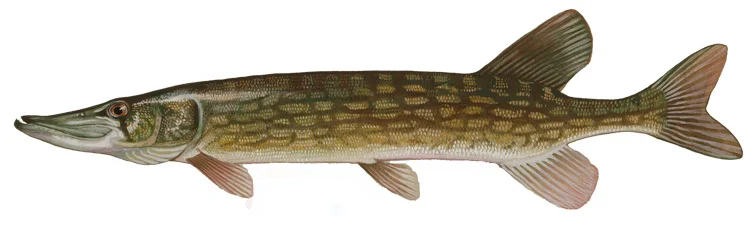
Identification: Chain pickerel are aggressive predators for small-to-moderate-sized prey items, like minnows, crayfish, small rodents and frogs. Spawning occurs over aquatic vegetation in the very early spring, which allows their hatching young to grow larger throughout the growing season of their first year of life. They can be differentiated from northern pike by the presence of a sub-ocular bar (a vertical black bar stretching from the bottom of the eye past the rear margin of the jaw) and the “chain-link fence” light color pattern along the sides of this aptly named pike. Both the chain pickerel and the northern pike can be differentiated from the musky by having a light-colored, circular pattern over a dark, olive-brown background.
Habitat: This species prefers small stream pool habitats but can also be found in abandoned channels, backwaters and floodplain wetlands of larger streams (such as the Ohio and Potomac rivers) that possess abundant aquatic vegetation and wood. Chain pickerel can tolerate high-water temperatures, high acidity (low pH) and low dissolved oxygen levels.
Other: Although not considered sport fish, they are similar in appearance to two additional species in West Virginia, grass pickerel and redfin pickerel. Both species obtain much smaller adult sizes than chain pickerel and differ in their lateral pattern.
Habitat & Range
This species prefers small stream pool habitats but can also be found in abandoned channels, backwaters and floodplain wetlands of larger streams (such as the Ohio and Potomac rivers) that possess abundant aquatic vegetation and wood. Chain pickerel can tolerate high-water temperatures, high acidity (low pH) and low dissolved oxygen levels.
Status, Trends & Threats
Chain pickerel continue to be stable throughout their range. There are no significant conservation issues for this species, although the channelization of streams and floodplain wetlands likely removes back-channel habitats where they thrive. Chain pickerel are often overlooked as a sport fish species in lieu of some of their larger counterparts of the pike family, such as northern pike and muskellunge. Angler catches appear to be declining in some Potomac River tributaries farther east in the state. This also appear to be occurring during a timeframe where the introduced musky is colonizing those same habitats.
License & Regulations
A valid West Virginia fishing license is required for anglers age 15 and older. Licenses are available for residents, non-residents, and short-term durations. A West Virginia Trout Stamp is required to fish for or possess trout in designated trout waters. Purchase online through the West Virginia Division of Natural Resources website or at authorized license retailers throughout the state.
Frequently Asked Questions
Identification
Chain pickerel are aggressive predators for small-to-moderate-sized prey items, like minnows, crayfish, small rodents and frogs. Spawning occurs over aquatic vegetation in the very early spring, which allows their hatching young to grow larger throughout the growing season of their first year of life. They can be differentiated from northern pike by the presence of a sub-ocular bar (a vertical black bar stretching from the bottom of the eye past the rear margin of the jaw) and the “chain-link fence” light color pattern along the sides of this aptly named pike. Both the chain pickerel and the northern pike can be differentiated from the musky by having a light-colored, circular pattern over a dark, olive-brown background.
Habitat
This species prefers small stream pool habitats but can also be found in abandoned channels, backwaters and floodplain wetlands of larger streams (such as the Ohio and Potomac rivers) that possess abundant aquatic vegetation and wood. Chain pickerel can tolerate high-water temperatures, high acidity (low pH) and low dissolved oxygen levels.
Interesting Facts
The longest West Virginia chain pickerel confirmed caught by rod and reel was 27.87 inches (Matt Born, 2019) and the heaviest weighed in at 6.19 pounds (Steven Demma, 2001). As an angler, it is important to realize that this species likes dense aquatic vegetation (like bluegill, largemouth bass and northern pike) and still water. A historical survey of Patterson Creek by District 2 staff uncovered a 14- inch chain pickerel from a recently abandoned stream channel with very little flow remaining from the main channel. The biologist at the time was conducting a study on chain pickerel diet selection. Within that fish’s stomach contents was another chain pickerel 8 inches long. Within that 8-inch fish’s stomach contents was yet another 4-inch chain pickerel!
Regulations
West Virginia fishing regulations apply to Chain Pickerel. A valid West Virginia fishing license is required for anglers 15 and older. Bag and size limits vary by species and water body. Some waters have special regulations including catch-and-release only, artificial lures only, or specific size limits. Check the West Virginia Division of Natural Resources Fishing Regulations for current rules specific to your fishing location.
References
| State | Category | Directory | Subcategory | Content | Source |
|---|---|---|---|---|---|
| West Virginia | Fishing | License | License & Fees | A valid West Virginia fishing license is required for anglers age 15 and older. Licenses are available for residents, no | Link |