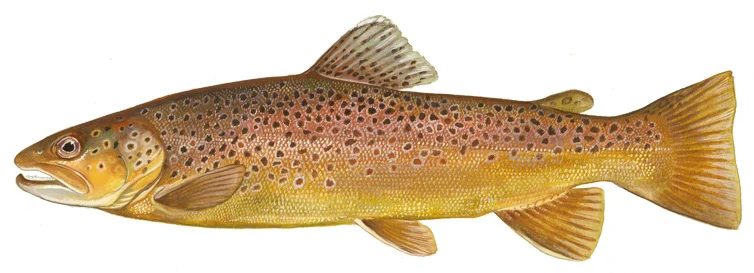
Identification: It seems anywhere anglers fish for trout, they admire this typically larger trout. Originally the fish hails from Europe, yet has been transferred nearly worldwide. The first fish were introduced to the Americas from Germany in 1883. Their native range extends from northern Norway and the White Sea tributaries in Russia to the Atlas Mountains in Northern Africa. The western limit of their native range is Iceland, while the eastern limits cover Afghanistan and Pakistan. Brown trout shift their feeding patterns as they age. Smaller fingerlings feed on much of what other trout species feed on before emerging as top predators, becoming piscivores. As they get larger, they prey and key on fish species, moving away from bottom forage. This enables them to grow quickly and outcompete smaller fish. Larger fish become more nocturnal, making them more difficult and finicky for anglers to catch. Brown trout can vary in appearance a good deal. Typically, they range from a dark brown to a yellow golden hue. Most brown trout are covered with black spots along their sides with a white to yellow underside. Halos are lightly colored with predominant red spots along the lateral line although not always typical, nor are spots on the tail.
Habitat: Brown trout have a higher tolerance to warmer temperatures than that other salmonid species. Temperature thresholds are upwards to 72 o F, yet they are less tolerant to a broad pH scale, preferring 6 to 9 pH. So long as the water is clean and cool, brown trout do well. The species does well in small streams but grows the largest in bigger rivers and streams, lakes and ponds. Habitat with large woody material enables the predator to conceal itself while seeking forage. Brown trout spawn in the fall months ranging from September to December. The fish key on the tail of pools where the water upwells, keeping the redd free of silt and well oxygenated. Care should be taken to identify these redds as to not disturb them. Spawning periods last usually two to four weeks.
Other: Brown trout are similar to other trout species except in spots and coloration.
Habitat & Range
Brown trout have a higher tolerance to warmer temperatures than that other salmonid species. Temperature thresholds are upwards to 72 o F, yet they are less tolerant to a broad pH scale, preferring 6 to 9 pH. So long as the water is clean and cool, brown trout do well. The species does well in small streams but grows the largest in bigger rivers and streams, lakes and ponds. Habitat with large woody material enables the predator to conceal itself while seeking forage. Brown trout spawn in the fall months ranging from September to December. The fish key on the tail of pools where the water upwells, keeping the redd free of silt and well oxygenated. Care should be taken to identify these redds as to not disturb them. Spawning periods last usually two to four weeks.
Status, Trends & Threats
Brown Trout are not listed as a species of concern. The largest conservation concern regarding brown trout in West Virginia is their ability to displace native species when placed over top of these populations. With a combination of size and diet, brown trout have the ability to displace native brook trout when the species overlap. Displacement is a result of a direct domination of best available habitat and predatory control of smaller trout species.
License & Regulations
A valid West Virginia fishing license is required for anglers age 15 and older. Licenses are available for residents, non-residents, and short-term durations. A West Virginia Trout Stamp is required to fish for or possess trout in designated trout waters. Purchase online through the West Virginia Division of Natural Resources website or at authorized license retailers throughout the state.
Frequently Asked Questions
Identification
It seems anywhere anglers fish for trout, they admire this typically larger trout. Originally the fish hails from Europe, yet has been transferred nearly worldwide. The first fish were introduced to the Americas from Germany in 1883. Their native range extends from northern Norway and the White Sea tributaries in Russia to the Atlas Mountains in Northern Africa. The western limit of their native range is Iceland, while the eastern limits cover Afghanistan and Pakistan. Brown trout shift their feeding patterns as they age. Smaller fingerlings feed on much of what other trout species feed on before emerging as top predators, becoming piscivores. As they get larger, they prey and key on fish species, moving away from bottom forage. This enables them to grow quickly and outcompete smaller fish...
Habitat
Brown trout have a higher tolerance to warmer temperatures than that other salmonid species. Temperature thresholds are upwards to 72 o F, yet they are less tolerant to a broad pH scale, preferring 6 to 9 pH. So long as the water is clean and cool, brown trout do well. The species does well in small streams but grows the largest in bigger rivers and streams, lakes and ponds. Habitat with large woody material enables the predator to conceal itself while seeking forage. Brown trout spawn in the fall months ranging from September to December. The fish key on the tail of pools where the water upwells, keeping the redd free of silt and well oxygenated. Care should be taken to identify these redds as to not disturb them. Spawning periods last usually two to four weeks.
Interesting Facts
The state record for brown trout has remained unbroken since 1968. The fish weighed 16 pounds and measured 32 inches. With stocking efforts and wild reproducing populations, there remains true opportunities to catch a trophy brown trout in the state. The world record is 42.1 pounds caught in New Zealand. This narrowly beats several United States records by less than a pound. Brown trout were the trout referenced in Isaac Walton’s book The Complete Angler. Where he wrote on the art of fly-fishing and the spirit of fishing.
Regulations
West Virginia fishing regulations apply to Brown Trout. A valid West Virginia fishing license is required for anglers 15 and older. Bag and size limits vary by species and water body. Some waters have special regulations including catch-and-release only, artificial lures only, or specific size limits. Check the West Virginia Division of Natural Resources Fishing Regulations for current rules specific to your fishing location.
References
| State | Category | Directory | Subcategory | Content | Source |
|---|---|---|---|---|---|
| West Virginia | Fishing | License | License & Fees | A valid West Virginia fishing license is required for anglers age 15 and older. Licenses are available for residents, no | Link |