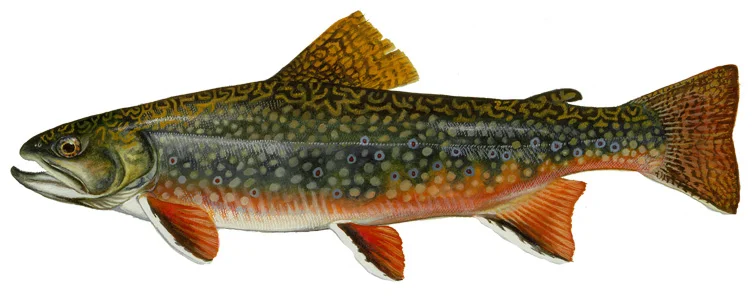
Identification: Brook trout are native to eastern North America, ranging from northern Georgia to Nova Scotia. When you witness the beauty of this fish, you will quickly understand why West Virginia and eight other states have designated the species as their state fish. Brookies tend to be dark green to brown in coloration. Males exhibit more vibrant orange bellies and white tipped fins, especially during spawning. Often the mouth of these fish will be black in coloration with males getting hooked jaws as they mature to reproductive age. While females are not typically as colored up, they too can show black mouths and white tipped fins. Female trout in general tend to have a more rounded head. Distinguishing blue halos surrounding brilliant red dots sprinkle their flanks. The most noticeable characteristic is the vermiculated pattern that runs down their back, spilling over slightly to the lateral line. Vermiculate translates to a wormy pattern. However, legend has it that this pattern is a map leading the angler to the beauty that brook trout fishing encompasses.
Habitat: When brook trout thrive in a stream, it indicates the water is clean, cold and highly oxygenated. In their Appalachian range, they are increasingly confined to higher elevations. Where conditions are favorable, they can be fished for in small mountain streams, rivers, and spring lakes and ponds. Large boulders and woody cover are preferred habitat. Temperature is a stress factor when exceeding 65 o F for extended periods of time. Brook trout waters typically range in pH from 5.0 to 7.5. Extremes have been observed in pH levels ranging as low as 3.5 and as high as 9.8.
Other: Brook trout are similar to other trout species except in spots and coloration.
Habitat & Range
When brook trout thrive in a stream, it indicates the water is clean, cold and highly oxygenated. In their Appalachian range, they are increasingly confined to higher elevations. Where conditions are favorable, they can be fished for in small mountain streams, rivers, and spring lakes and ponds. Large boulders and woody cover are preferred habitat. Temperature is a stress factor when exceeding 65 o F for extended periods of time. Brook trout waters typically range in pH from 5.0 to 7.5. Extremes have been observed in pH levels ranging as low as 3.5 and as high as 9.8.
Status, Trends & Threats
While listed as globally secure, native brook trout face threats to their distribution with population disappearing as early as the late 19 th century. Brook trout populations in many historical streams were wiped out when the old-growth forests were timbered and the streams were exposed to extended periods of sunlight, resulting in stream temperatures too high for brook trout survival. As these forests were cleared for development, the shade diminished and the water became to warm and sediment laden for populations to remain intact. Pollution, dams and competition with non-natives species represent detrimental impacts to the viability of the success of the species. Brook trout spawn during the fall months of September through November. As they spawn, the nest created are known as redds, which are placed near the low end of pools where currents keep the nest free of silt and the eggs well oxygenated. Anglers should be aware of spawning times, and redd areas should be avoided if wading
License & Regulations
A valid West Virginia fishing license is required for anglers age 15 and older. Licenses are available for residents, non-residents, and short-term durations. A West Virginia Trout Stamp is required to fish for or possess trout in designated trout waters. Purchase online through the West Virginia Division of Natural Resources website or at authorized license retailers throughout the state.
Frequently Asked Questions
Identification
Brook trout are native to eastern North America, ranging from northern Georgia to Nova Scotia. When you witness the beauty of this fish, you will quickly understand why West Virginia and eight other states have designated the species as their state fish. Brookies tend to be dark green to brown in coloration. Males exhibit more vibrant orange bellies and white tipped fins, especially during spawning. Often the mouth of these fish will be black in coloration with males getting hooked jaws as they mature to reproductive age. While females are not typically as colored up, they too can show black mouths and white tipped fins. Female trout in general tend to have a more rounded head. Distinguishing blue halos surrounding brilliant red dots sprinkle their flanks. The most noticeable characteristi...
Habitat
When brook trout thrive in a stream, it indicates the water is clean, cold and highly oxygenated. In their Appalachian range, they are increasingly confined to higher elevations. Where conditions are favorable, they can be fished for in small mountain streams, rivers, and spring lakes and ponds. Large boulders and woody cover are preferred habitat. Temperature is a stress factor when exceeding 65 o F for extended periods of time. Brook trout waters typically range in pH from 5.0 to 7.5. Extremes have been observed in pH levels ranging as low as 3.5 and as high as 9.8.
Interesting Facts
Brook trout are West Virginia’s only native trout species. There are 500 miles of native trout streams in West Virginia. Most of these streams are small and comprise 2 percent of total miles of stream in the state. To minimize the effects of acid rain and snow, WVDNR uses limestone to adjust the pH to a more suitable level for survival and population expansion. Brook trout are known by several other names such as specks, brook char and speckled trout. Some populations venture into lakes or marine environments. These fish get larger than stream fish and are referred to locally as coasters or salters. Brook trout can sometimes cross with brown trout, resulting in a more aggressive tiger trout. The species has been transplanted to the western United States, where they are considered to be a n...
Regulations
West Virginia fishing regulations apply to Brook Trout. A valid West Virginia fishing license is required for anglers 15 and older. Bag and size limits vary by species and water body. Some waters have special regulations including catch-and-release only, artificial lures only, or specific size limits. Check the West Virginia Division of Natural Resources Fishing Regulations for current rules specific to your fishing location.
References
| State | Category | Directory | Subcategory | Content | Source |
|---|---|---|---|---|---|
| West Virginia | Fishing | License | License & Fees | A valid West Virginia fishing license is required for anglers age 15 and older. Licenses are available for residents, no | Link |