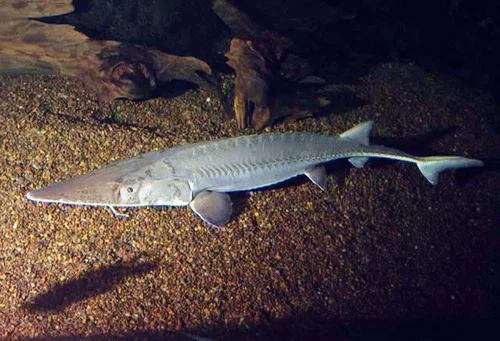
Description: Grows up to seven feet in length. Light gray in color with a lighter underside. Small black eyes set on a shovel-shaped head. Four barbels on the underside of the head with the two inner barbels shorter than the outer two. This distinguishes it from the common shovelnose sturgeon. The top side of its body is covered in large scales called scutes.
Status: Year-round resident. Abundance: Rare.
Threats: Destruction and alteration of habitats by human modification of the river system is likely the primary cause of declines in reproduction, growth, and survival of Pallid Sturgeon (USFWS 1993). Much of the species’ habitat was destroyed when a number of large dams were constructed on the Missouri River, producing a number of large reservoirs. These structures changed the velocity, volume and timing of flows in the river from pre-impoundment. In the system much of the remaining river has been channelized. This has changed the velocity, reduced the width of the river, and prevented water flow into backwater areas important to this species (USFWS 1993).
Habitat: Big Rivers Lakes and Reservoirs Pallid Sturgeon are well adapted for life on the bottom of a fast flowing, turbid river. Generally found in stretches of river with 40 to 90 cubic feet per second velocity. Areas at the end of chutes or sandbars are commonly used, most likely for energy conservation and feeding. The range of depths used varies seasonally, with most fish being found shallow in the spring and deeper in the fall. Pallid Sturgeons are most commonly found in the upper Missouri River upstream of Lake Sakakawea, and in the Yellowstone River near the confluence of the two rivers.
Habitat & Range
Big Rivers Lakes and Reservoirs Pallid Sturgeon are well adapted for life on the bottom of a fast flowing, turbid river. Generally found in stretches of river with 40 to 90 cubic feet per second velocity. Areas at the end of chutes or sandbars are commonly used, most likely for energy conservation and feeding. The range of depths used varies seasonally, with most fish being found shallow in the spring and deeper in the fall. Pallid Sturgeons are most commonly found in the upper Missouri River upstream of Lake Sakakawea, and in the Yellowstone River near the confluence of the two rivers.
Status, Trends & Threats
Destruction and alteration of habitats by human modification of the river system is likely the primary cause of declines in reproduction, growth, and survival of Pallid Sturgeon (USFWS 1993). Much of the species’ habitat was destroyed when a number of large dams were constructed on the Missouri River, producing a number of large reservoirs. These structures changed the velocity, volume and timing of flows in the river from pre-impoundment. In the system much of the remaining river has been channelized. This has changed the velocity, reduced the width of the river, and prevented water flow into backwater areas important to this species (USFWS 1993).
Fishing Season
Open year-round (April 1 – March 31)
License & Regulations
A valid North Dakota fishing license is required for anglers 16 and older. Resident and non-resident licenses are available. Two free fishing days per year (typically in June and December) allow fishing without a license. Purchase licenses online through the North Dakota Game and Fish Department website.
Frequently Asked Questions
Regulations
Protected: Must be immediately released if caught.
Size
Grows up to seven feet in length. Light gray in color with a lighter underside. Small black eyes set on a shovel-shaped head. Four barbels on the underside of the head with the two inner barbels shorter than the outer two. This distinguishes it from the common shovelnose sturgeon. The top side of its body is covered in large scales called scutes.
References
| State | Category | Directory | Subcategory | Content | Source |
|---|---|---|---|---|---|
| North Dakota | Fishing | Regulations | Season Dates | Open year-round (April 1 – March 31) | Link |
| North Dakota | Fishing | License | License & Fees | A valid North Dakota fishing license is required for anglers 16 and older. Resident and non-resident licenses are availa | Link |