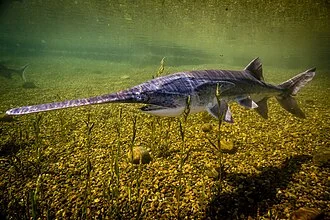
Description: Can grow seven feet in length and weigh over 100 pounds. Large paddle-shaped snout. Smooth skin has no scales. Color ranges from blue gray to nearly black with a lighter underside. Long fleshy gill covers.
Status: Year-round resident.
Threats: Impoundments along the Missouri River System have changed the flow regime of the river and cover needed for spawning habitat. Slower flows have allowed silt to cover important gravel beds, making them unusable by spawning fish. As a result, reproduction only occurs in the wild when conditions are favorable in the Yellowstone River. Dams have also impeded the movement of fish throughout the system, separating populations. This brings up concerns about genetic integrity. Over-harvest for the fishes’ valuable roe is a concern for this species. The North Dakota Game and Fish Department regulates a controlled harvest for Paddlefish as a sport fish.
Habitat: Big Rivers Lakes and Reservoirs In summer months, slack water areas of a river are a preferred habitat for Paddlefish. If this is not available, areas of low flow are sought such as behind sandbars, wing dams, or other structures. In winter Paddlefish move into the deeper water of Lake Sakakawea. Paddlefish spawn in the spring and lay their eggs over silt-free gravel beds. The two most important areas for Paddlefish in North Dakota are the Missouri River from upper Lake Sakakawea to the Montana border, and the Yellowstone River. These two river stretches are used by the Paddlefish as migration routes to their spawning areas.
Habitat & Range
Big Rivers Lakes and Reservoirs In summer months, slack water areas of a river are a preferred habitat for Paddlefish. If this is not available, areas of low flow are sought such as behind sandbars, wing dams, or other structures. In winter Paddlefish move into the deeper water of Lake Sakakawea. Paddlefish spawn in the spring and lay their eggs over silt-free gravel beds. The two most important areas for Paddlefish in North Dakota are the Missouri River from upper Lake Sakakawea to the Montana border, and the Yellowstone River. These two river stretches are used by the Paddlefish as migration routes to their spawning areas.
Status, Trends & Threats
Impoundments along the Missouri River System have changed the flow regime of the river and cover needed for spawning habitat. Slower flows have allowed silt to cover important gravel beds, making them unusable by spawning fish. As a result, reproduction only occurs in the wild when conditions are favorable in the Yellowstone River. Dams have also impeded the movement of fish throughout the system, separating populations. This brings up concerns about genetic integrity. Over-harvest for the fishes’ valuable roe is a concern for this species. The North Dakota Game and Fish Department regulates a controlled harvest for Paddlefish as a sport fish.
Fishing Season
Open year-round (April 1 – March 31)
License & Regulations
A valid North Dakota fishing license is required for anglers 16 and older. Resident and non-resident licenses are available. Two free fishing days per year (typically in June and December) allow fishing without a license. Purchase licenses online through the North Dakota Game and Fish Department website.
Frequently Asked Questions
Size
Can grow seven feet in length and weigh over 100 pounds. Large paddle-shaped snout. Smooth skin has no scales. Color ranges from blue gray to nearly black with a lighter underside. Long fleshy gill covers.
Regulations
Paddlefish: 1 per season by snagging only (May 1–21). Must be immediately released if caught by hook & line.
References
| State | Category | Directory | Subcategory | Content | Source |
|---|---|---|---|---|---|
| North Dakota | Fishing | Regulations | Season Dates | Open year-round (April 1 – March 31) | Link |
| North Dakota | Fishing | License | License & Fees | A valid North Dakota fishing license is required for anglers 16 and older. Resident and non-resident licenses are availa | Link |