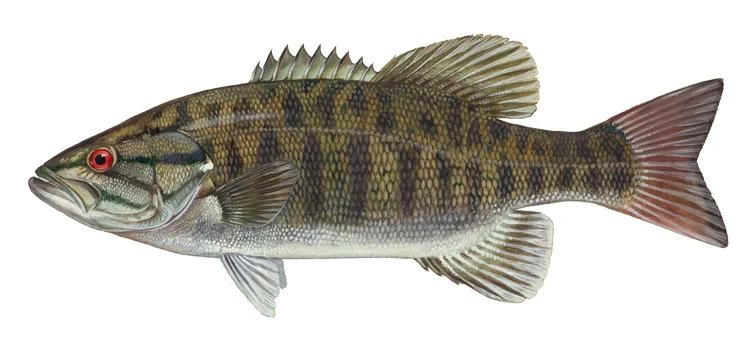
These bass are slender with a projecting lower jaw and an upper jaw that never extends further back of the eyes. Cheeks display at least three dark lines, but no dark lateral line appears on the side. Smallmouth bass are an olive green or a brown color on the head as well as the back area with the belly area a cream or white color. The sides are yellowish green with bronze vertical markings, and dark brown markings are seen down both sides of the head. Smallmouth can reach lengths of over 24 inches and weights of almost 8 pounds.
Habitat & Range
Smallmouth bass prefer cool streams as well as clear, cool reservoirs and lakes with rock or gravel bottoms. In Mississippi, smallmouth bass are only found in the Tennessee River and Bear Creek systems, especially Pickwick Lake. The diet of smallmouth bass changes as they grow, changing from plankton, small aquatic insects, and small crustaceans to larger aquatic and terrestrial insects, crayfish, and small fish. Spawning occurs during the spring (April ”?May) with water temperatures around 60°F to 78°F. Smallmouth bass construct nests in gravel and also under tree roots and stumps. Males can spawn with different females, and males guard the nests after spawning and immediately after hatching occurs.
Frequently Asked Questions
State Record
Mississippi’s Rod and Reel record is 7 pounds 15 ounces, caught by Thomas Wilbanks in Yellow Creek (Pickwick Lake) in 1987.
Fishing Tips
Crank baits, jigs, minnows, or crayfish (artificial or natural) are excellent baits to use when trying to catch smallmouth bass. Footer Accessibility Careers Contact Us Privacy Policy Staff Portal License Support: 1-800-5GOHUNT Main Office: 1-601-432-2400 1505 Eastover Drive, Jackson, MS 39211 Copyright 2023-2026 Mississippi Department of Wildlife, Fisheries, and Parks, All Rights Reserved.