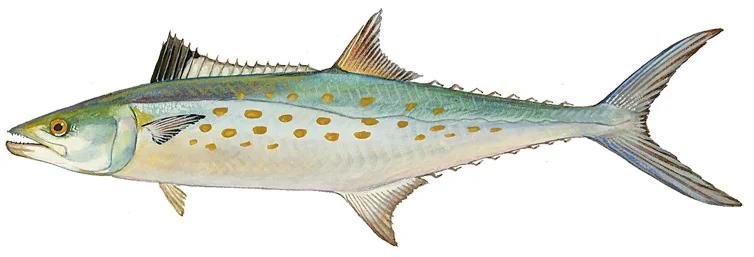
Spanish Mackerel are greenish along the back with silver sides and belly. Yellow or olive oval spots traverse the body, which is covered with very tiny scales. Spanish Mackerel and juvenile king mackerel can be easily confused. Juvenile king mackerel will sometimes have the yellowish spots much the same as mature Spanish mackerel . A juvenile king mackerel’s lateral line dips significantly compared to a Spanish Mackerel . The dorsal fin of a Spanish will be black or very dark in color. A juvenile king’s dorsal fin will be a much lighter, more of a gray or white color. Spanish Mackerel can also be easily confused with the cero mackerel. Spanish Mackerel and cero mackerel are generally the same size and can look very similar. Spanish Mackerel lack the distinct orange to bronze band or stripe found on cero mackerel.
Diet: small fishes with lesser quantities of shrimps and squids
Habitat & Range
Spanish Mackerel is a shallow water species, preferring sand bottom in depths of 10 to 40 feet. They feed on small fishes with lesser quantities of shrimps and squids.
Where to Fishing
Atlantic Ocean and Delaware Bay
Fishing Season
All year
Frequently Asked Questions
Fishing Tips
Spanish Mackerel are caught by casting shiny spoons and jigs or trolling various live and dead baitfish, feathered jigs, cedar plugs and other artificial lures. Fast lure retrieves are key to catching these quick fish. Small live baitfish will also take Spanish Mackerel .
References
| State | Category | Directory | Subcategory | Content | Source |
|---|---|---|---|---|---|
| Delaware | Fishing | Regulations | Season Dates | All year | Link |