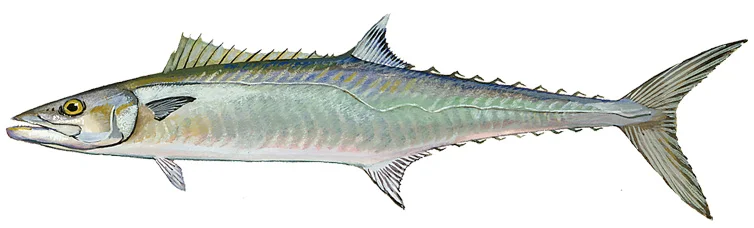
The body of the King Mackerel is iron-gray along the back, and silvery on the sides and belly. Juvenile King Mackerel and adult Spanish Mackerel can be easily confused. Juvenile King Mackerel will sometimes have the yellowish spots much the same as mature Spanish mackerel. A juvenile King Mackerel ’s lateral line dips significantly compared to a Spanish Mackerel. The dorsal fin of a juvenile King will be a much lighter color, more of a gray or white color than the Spanish, whose dorsal fin will be black or very dark in color.
Diet: squids, shrimps, and fishes
Habitat & Range
King Mackerel inhabit high salinity, green ocean waters, near the surface or at moderate depths. They may move inshore on higher tides and during the summer. Often associated with artificial reefs, wrecks, and buoys, they feed on squids, shrimps, and fishes.
Where to Fishing
Atlantic Ocean
Frequently Asked Questions
Fishing Tips
King Mackerel are taken mostly by trolling, using various live and dead baitfish, shiny spoons, feathered jigs, cedar plugs and other artificial lures.