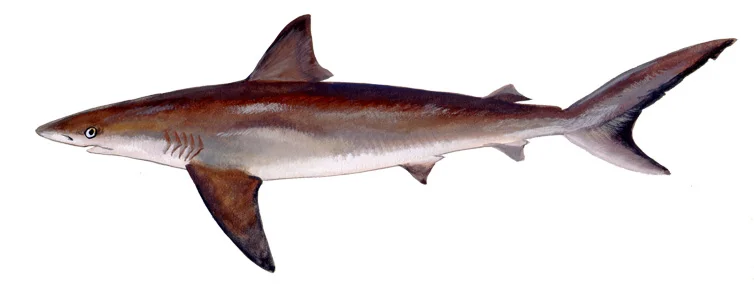
The Dusky Shark is often mistaken for the sandbar shark. The Dusky Shark is a large shark with a long streamlined body. The upper side is brown to gray with the underside white. They are very similar in appearance to the sandbar shark but can be distinguished by its smaller dorsal fin. The underside of the pectoral fins, anal fin and the lower caudal fin lobe darken towards the tips; this is more obvious in juveniles. They have a defined interdorsal ridge (ridge of skin going down the back between the two dorsal fins). The upper and lower teeth are nearly erect. The upper teeth are triangular with serrated edges. The lower teeth are narrower and more finely serrated.
Diet: fishes, sharks, skates, rays, crabs, octopi, and squids
Habitat & Range
The Dusky Shark ranges from shallow inshore waters to deep, wide open waters. Although generally a bottom feeder, it can be found from the surface to a depth of over 1000 feet. They feed on fishes, sharks, skates, rays, crabs, octopi, and squids.
Where to Fishing
Atlantic Ocean
Fishing Season
The sandbar & sand tiger are toothed sharks commonly taken in the nearshore waters of the state and are prohibited species. Like all prohibited species, they must be immediately released to ensure the maximum probability of survival.
Frequently Asked Questions
Fishing Tips
It is unlawful to release a Dusky Shark in a manner that will not ensure the shark's maximum probability of survival (e.g., no gaffs, no clubbing, careful hook removal, etc.). It is unlawful for any hook and line fisherman to remove a Dusky Shark from the water.
References
| State | Category | Directory | Subcategory | Content | Source |
|---|---|---|---|---|---|
| Delaware | Fishing | Regulations | Season Dates | The sandbar & sand tiger are toothed sharks commonly taken in the nearshore waters of the state and are prohibited speci | Link |