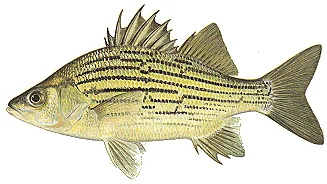
The yellow bass is named for its characteristic yellowish gold body and eye. Black longitudinal stripes occur as continuous lines along the back, but the lower three or four along the sides and venter are distinctly broken. The lateral line is complete with 50 to 55 scales. The tongue lacks the distinctive tooth patch found on other members of this group. See Eigenmann (1887) for original description.
Distribution: Morone mississippiensisis distributed from the Mobile basin west to the San Jacinto River, Texas. It is native to the lower Tombigbee and Tennessee rivers as well as the Mobile Delta. Dan Catchings of the Alabama Wildlife and Freshwater Fisheries confirmed that yellow bass have been introduced into select areas of the upper Cahaba River system, including Lake Purdy. Two specimens were collected in Lake Purdy in June 1982. Jim McHugh, also of the Alabama Wildlife and Freshwater Fisheries Division, reported two collections from the Black Warrior River in 1989 and confirmed that individuals had been stocked in Inland Lake. We have no samples to date, but Walter Hubbard of the Mississippi Department of Wildlife reported that yellow bass, presumably from the Tennessee River, have entered the upper Tombigbee River via the Tennessee-Tombigbee Waterway (Boschung, 1992).
Original Description: Jordan and Eigenmann described yellow bass in 1887.
Etymology: Moroneorigin of this genus name is unknown.Mississippiensismeans of the Mississippi River.
Habitat & Range
Populations of this schooling species occur more frequently in medium to large tributaries and backwater areas of reservoirs and rivers. In Missouri (Pflieger, 1975) and Tennessee (Etnier and Starnes, 1993), yellow bass migrate into large streams to spawn in April and May. Our collections of gravid males and females in the lower Tombigbee River system and the Tennessee River drainage in April support their observations. Spawning usually occurs between one to several males and a single female. Yellow bass feed mainly on insect larvae and small fishes, including minnows, silversides, and small threadfin shad. The maximum life span is estimated to be six years (Priegel, 1975).
Frequently Asked Questions
White Bass — Regulations
Daily Creel Limit: 15 Notes: See exceptions for the Chattahoochee River and its impoundments and tributaries in the Size Limits section below.
Size
8 to 11 in (203 to 279 mm).
State Record
a list of theState Record Freshwater Fish.