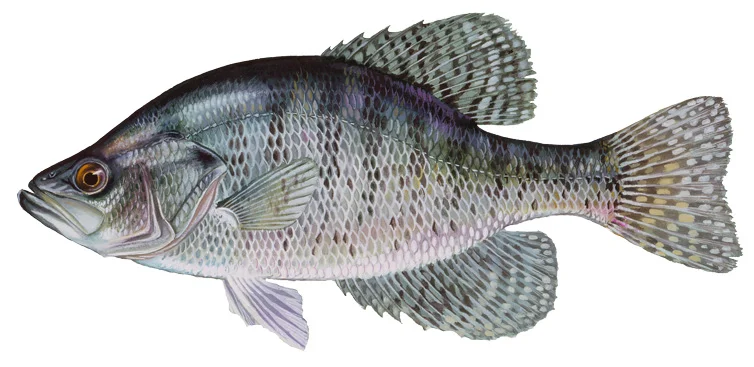
The white crappie or papermouth is a laterally compressed, deep-bodied fish with relatively large dorsal and anal fins. The completely joined dorsal fin contains five to six spines and 14 or 15 rays. The anal fin is slightly larger than the dorsal fin and has five to seven spines and 16 to 18 rays. The distance from the rear margin of the eye to the dorsal fin origin is usually longer than the length of the dorsal fin base. The back and upper sides are light gray to green, the lower sides are silvery, and the venter is white. Eight to 10 vertical, dark gray reticulated bars occur along the sides, with gray mottling on the venter and between the lateral bars. Dark margins occur on numerous scales in the nape and breast region, particularly during the spawning season. The dorsal, caudal, and anal fins contain several alternating light and dark bands. See Rafinesque (1818c) for original description.
Distribution: White crappie occur naturally from the Mississippi Valley east to the Appalachian foothills and along the Gulf Coast from Florida to Texas. Individuals found east of the Mobile basin may have resulted from introductions (Smith-Vaniz, 1968). Introduction of the white crappie has expanded its native range to include most of the United States and parts of northern Mexico.
Original Description: Rafinesque originally described the white crappie in 1818.
Etymology: Pomoxismeans sharp opercle.Annularismeans having rings, probably referring to the reticulated bars on the sides of the body.
Habitat & Range
White crappie live primarily in rivers and reservoirs, although small individuals occasionally enter small streams. This species seems to tolerate more turbidity than does the black crappie. Prior to spawning, adult crappie aggregate into schools, move into shallow water, and aggressively feed on threadfin shad and small minnows. During this time (usually when the dogwoods begin to bloom), anglers catch thousands of white and black crappie on live minnows and jigs around aquatic vegetation, submerged logs, and other structures. Spawning occurs from April into early June. White crappie live for nine years in Reelfoot Lake, Tennessee (Schoffman, 1965). Crappie will survive in lakes, but without proper management, populations become overcrowded, resulting in smaller fish and adversely affecting the sizes and recruitment of bluegill and largemouth bass (McHugh, 1990).
Frequently Asked Questions
Crappie — Regulations
Daily Creel Limit: 30 Size Limit: It is illegal to possess any Crappie less than nine inches in total length taken from Alabama public waters, including Aliceville Reservoir and Pickwick Reservoir. Waters exempt from the nine-inch Crappie limit include impoundments less than 500 surface acres, and the reciprocal waters of the Chattahoochee River and Impoundments and their tributaries, Bear Creek Reservoir (Big Bear Lake of the B.C.D.A. Lakes), Lake Jackson at Florala and Weiss Reservoir. See exception for Weiss Reservoir.
Size
12 to 20 inches (300 to 508 mm).
State Record
a list of theState Record Freshwater Fish.