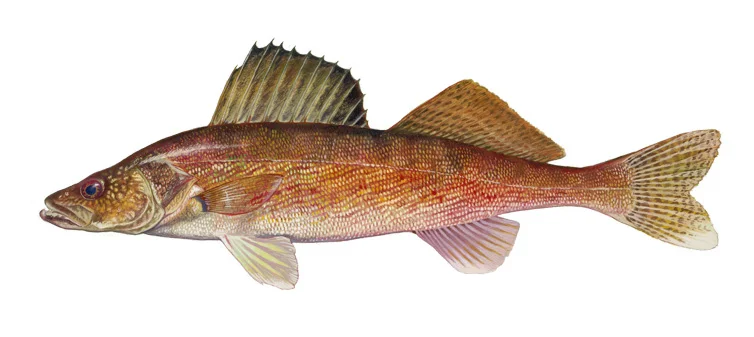
The walleye is similar in appearance to the sauger but can be distinguished by the large black spot at the posterior base of the walleye’s spiny dorsal fin and by the white tip on the lower lobe of the caudal fin. Walleye have a large horizontal mouth with large pointed teeth. The body color is olive to brassy yellow with extensive mottling along the sides and a white or light cream venter. The six to seven saddles on the back are diffuse and ill-defined. The soft dorsal fin and caudal fin rays are pigmented, producing a somewhat mottled yet banded pattern. Spots on the spiny dorsal fin are small with no definite pattern or banding. Like the sauger, the walleye has a characteristic lining behind the retina that makes the eye look silver.
Distribution: The walleye is widespread, naturally and from introductions, from the Mackenzie River in the Northwest Territories south to the lower Mississippi River basin and from the Atlantic Coast west to Nevada and Oregon. We have records of walleye throughout the Mobile basin both above and below the Fall Line. This species also occurs in the Tennessee River drainage as catches are commonly reported by fishermen, but our recent sampling has failed to capture walleye there.
Original Description: Mitchill described walleye in 1818.
Etymology: Stizostedionmeans interpreted by Rafinesque (1820) as Greek for pungent throat, referring to the large canine teeth lining the jaws and roof of the mouth.Vitreummean glassy, referring to the large, silvery eye.
Habitat & Range
Life history information is summarized from Becker (1983). The walleye is associated with large rivers and stream tributaries and impoundments, frequently preferring clear, quiet backwaters over sand, gravel, mud, rubble, and silt. During spawning individuals move to shoal areas or tailwaters over riprap downstream of dams. Spawning occurs from March through May with eggs broadcast in open water over suitable spawning substrate. Inlet streams to impoundments are known spawning grounds in those habitats. A life span of seven years is common with a few individuals surviving to be 10 to 12 years of age. Young walleye feed on microcrustaceans and insect larvae, while larger individuals prey on fish, including white suckers, quillbacks, darters, and minnows. Feeding usually occurs at night when individuals migrate from deeper areas to shallow shoals.
Frequently Asked Questions
Walleye — Regulations
Daily Creel Limit: 2 Notes: It shall be illegal to take or attempt to take walleye by any method from Sweetwater Lake located in the Talladega National Forest, Cleburne County, from White Plains Lake (also known as Whitesides Mill Lake), Calhoun County and from Shoal Creek upstream of White Plains Lake, Calhoun and Cleburne Counties. It shall also be illegal to take or attempt to take walleye by any method from Lake Mitchell on the Coosa River between Mitchell Dam and Lay Dam or from its tributary streams; Walnut Creek in Chilton County, Hatchet Creek in Coosa and Clay Counties, Weogufka Creek in Coosa County, and the Mulberry Fork River and Sipsey Fork River or any of their tributary streams in Blount, Cullman, Lawrence, Walker, and Winston Counties. Any walleye taken in these lakes or streams shall immediately be released back into the waters from which they were taken with least possible harm.
Size
12 to 31 in (300 to 787 mm).
State Record
a list of theState Record Freshwater Fish.