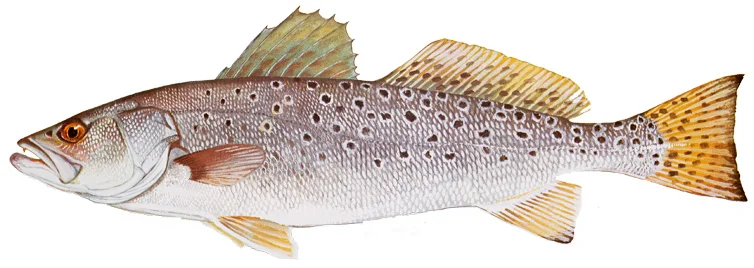
Locally known as “speck” or speckled trout, the spotted seatrout is distinguished by small spots arranged in oblique rows along the upper sides and back and by the presence of large canine teeth. The body is generally silvery and dark gray-green on the sides and back. The caudal fin of young individuals is shaped like a lance head, becoming straight-edged or slightly concave in adults. All fins are pale green to yellow-green, and the dorsal and anal fins have scattered black spots. The somewhat elongate snout has a prominent mouth sporting large canine teeth, testifying to a piscivorous mode of life.
Remarks: The spotted seatrout is an extremely important game fish in the Mobile Delta.
Distribution: The spotted seatrout occurs in coastal environments from New England southward in Atlantic Coast drainages through Florida and Gulf Coast drainages into Mexico. Although this is not reflected on the adjacent map due to the freshwater emphasis of our study.
Original Description: Cuvier described the spotted seatrout in 1830.
Etymology: Cynoscionmeans doglike, probably referring to the large canine teeth.Nebulosusmeans spotty, referring to the dark spots found along the sides of the body.
Habitat & Range
Specks usually inhabit large, shallow, grassy flats of estuarine waters. Adjacent channels and deep pools provide refuge during rapid temperature changes in winter months. Wade (1979) reports that spotted seatrout generally live within a 30-mile range, but movement of over 300 miles has been documented. Spawning occurs at night from May through September, with some adults reaching sexual maturity by the end of their first year. Spawning areas are thought to be deeper depressions and channels in bays adjacent to their preferred shallow, grassy flats. Foods of adult spotted seatrout include shrimp and small fin fish, while juveniles feed primarily on invertebrates.
Frequently Asked Questions
Spotted Seatrout — Regulations
Daily Creel Limit: 6 per person - one fish is allowed to be over Size Limit: 15" min. TL - 22" max TL
Size
10 to 24 in (254 to 610 mm). The state angling record (12 lb, 4 oz) was caught in 1980.