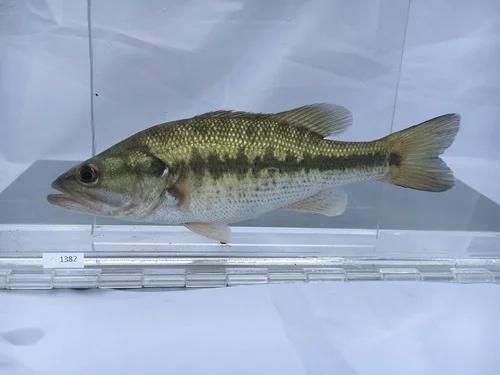
Also known as Kentucky bass, the spotted bass is a slender fish with black blotches along the middle of the body; with age, these join to form an irregular band. Hubbs and Bailey (1940) recognize two subspecies in Alabama.Micropterus punctulatus punctulatusoccurs in the Tennessee River and has 58 to 71 lateral line scales and 22 to 27 scales around the caudal peduncle.Micropterus p. henshalliis limited to the upper Mobile basin and has 68 to 77 lateral line scales and 26 to 29 caudal peduncle scales. Intergrades are distributed below the Fall Line in the Mobile basin. In 2008, Bakeret al. elevatedMicropterus p. henshallito species status,M. henshalli, with the common name of Alabama bass. Both species and their intergrades have a large mouth, the upper jaw extending almost to the rear margin of the eye. A rectangular tooth patch on the tongue distinguishes these species from largemouth bass. The dorsal fin has nine to 11 (usually 10) spines and 11 to 13 rays that are broadly joined. The anal fin has three spines and nine to 11 rays. The bases of the soft dorsal and anal fins are scaled. The body is olive green on the back with scattered dark mottling. The sides below the lateral blotches are light gray; many scales have dark spots forming horizontal rows. The venter is white. Juveniles have a black spot in the middle of the caudal fin base bordered by bright orange areas. The eyes are usually reddish but not as bright as those of redeye bass.
Distribution: Spotted bass are native throughout Alabama with the possible exception of the Apalachicola River Basin.
Original Description: Rafinesque described the spotted bass in 1819.
Etymology: Micropterusmeans small fin.Punctulatusmeans dotted.
Habitat & Range
Spotted bass usually occur around aquatic vegetation, submerged logs, and rock or riprap walls in small to large flowing streams, rivers, and reservoirs. Spawning occurs in April and May, often in the mouths of tributary streams. The male guards the nest until the fry have hatched. Food items include small fishes, crayfishes, and aquatic insects. Gilbert (1973) reports thatM. henshalligrows faster thanM. punctulatus.Life spans of southeastern populations vary from four to seven years.
Frequently Asked Questions
Black Bass — Regulations
Daily Creel Limit: 10 Notes: Includes combinations of largemouth, smallmouth, spotted, Alabama, shoal and those species formerly known as “redeye” bass, which are now known separately as Coosa, Warrior, Cahaba, Tallapoosa and Chattahoochee bass, based on their respective drainages. The Alabama bass was formerly known as spotted bass in the Mobile drainage. No more than 5 of the daily creel limit of 10 may be smallmouth bass. See exceptions for shoal bass in specific tributaries of the Chattahoochee River.
Black Bass — Regulations
Daily Creel Limit: 10 Notes: Includes combinations of largemouth, smallmouth, spotted, Alabama, shoal and those species formerly known as “redeye” bass, which are now known separately as Coosa, Warrior, Cahaba, Tallapoosa and Chattahoochee bass, based on their respective drainages. The Alabama bass was formerly known as spotted bass in the Mobile drainage. No more than 5 of the daily creel limit of 10 may be smallmouth bass. See exceptions for shoal bass in specific tributaries of the Chattahoochee River.
Size
12 to 17 in (300 to 432 mm).
State Record
a list of theState Record Freshwater Fish.