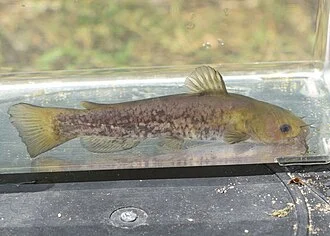
When viewed from the side, the head of the snail bullhead is flattened and the snout is rounded. The short, rounded anal fin contains 16 to 22 (usually 17 to 20) rays. The pectoral spine has numerous small teeth on its anterior and posterior edges. Color on the back varies from light olive to black, grading to pale yellow on the sides and creamy white on the venter. The fins are dusky to brown, with a narrow black band along the margin. See Jordan (1877a) for original description.
Remarks: Yerger and Relyea (1968) report that Chattahoochee fishermen prefer snail bullheads to either channel catfish or white catfish, claiming that the flesh of snail bullheads has a better flavor.
Distribution: Snail bullheads are limited to the Chattahoochee River drainage in Alabama and the upper Etowah (Coosa) River system in Georgia. Collection records in Lee and Russell counties are the result of several years of intensive sampling efforts by John S. Ramsey and fisheries students at Auburn University. The lack of additional records from the rest of this species’ range is probably due to the scarcity of optimum habitats below the Fall Line and the likelihood that sampling was done without boat electrofishing gear and gill nets.
Original Description: Jordan described the snail bullhead in 1877.
Etymology: Ameiurusmeans unforked caudal.Brunneusmeans brown, the color pattern of young and juveniles, on which the species description is based.
Habitat & Range
Snail bullheads prefer deep, fast-flowing streams and rivers with sand and rock substrates. The life history of this species is not well known. Observations in Florida indicate that it has a protracted spawning season that may last from spring through mid-summer (Yerger and Relyea, 1968). Small fishes, aquatic vegetation, and snails of the genusElimiamake up the snail bullhead’s diet.
Frequently Asked Questions
Catfish — Regulations
Notes: —
Size
10 to 12 in (254 to 300 mmm)