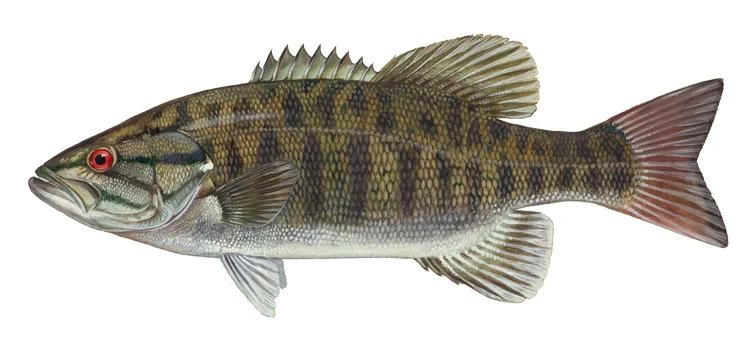
The dorsal fin on the smallmouth bass is distinctly separated and contains nine to 11 spines and 13 to 15 rays. The anal fin has three spines and 10 or 11 rays. The bases of the soft dorsal and anal fins are covered with scales. The complete lateral line has 68 to 80 scales. The mouth is relatively large, with the upper jaw almost reaching the rear margin of the eye. The eye may have a reddish tint. Smallmouth bass lack the characteristic black stripe or jointed, lateral black blotches found on largemouth and spotted bass. Instead, the back and sides are bronze to olive green, with many irregularly spaced dark spots. The venter is generally white in small individuals, becoming dusky with age. Young smallmouth bass have several vertically oriented dark blotches along their sides that usually fade with age.
Remarks: The smallmouth bass is a favorite game fish across much of the eastern United States. The tailwater area below Wheeler Lock and Dam is one of the premier smallmouth fishing areas in North America, and several world line-class records have been set there in recent years. Most anglers fishing the tailwaters either drift or anchor below the dam while using live bait or bouncing artificial jigs along the bottom.
Distribution: Smallmouth bass are native to the Tennessee River drainage. They have been unsuccessfully introduced into Smith Lake (Black Warrior River) and the Cahaba, Coosa and upper Tombigbee rivers.
Original Description: Lacepède described smallmouth bass in 1802.
Etymology: Micropterusmeans small fin.Dolomieurecognizes M. Dolomieu, a French mineralogist.
Habitat & Range
Smallmouth bass inhabit clear, small to medium-sized streams, rivers, and reservoirs. They favor such underwater structures as rock outcrops, logs, treetops, and constructed riprap walls. Spawning usually occurs in April and May, when water temperatures reach 59º to 63ºF (15º to 18ºC) (Hubbs and Bailey, 1938). Smallmouth feed primarily on small fishes, crayfishes, and insects (Hubert, 1977). Carlander (1977) reports life spans of six to 14 years in southern and northern populations.
Frequently Asked Questions
Black Bass — Regulations
Daily Creel Limit: 10 Notes: Includes combinations of largemouth, smallmouth, spotted, Alabama, shoal and those species formerly known as “redeye” bass, which are now known separately as Coosa, Warrior, Cahaba, Tallapoosa and Chattahoochee bass, based on their respective drainages. The Alabama bass was formerly known as spotted bass in the Mobile drainage. No more than 5 of the daily creel limit of 10 may be smallmouth bass. See exceptions for shoal bass in specific tributaries of the Chattahoochee River.
Black Bass — Regulations
Daily Creel Limit: 10 Notes: Includes combinations of largemouth, smallmouth, spotted, Alabama, shoal and those species formerly known as “redeye” bass, which are now known separately as Coosa, Warrior, Cahaba, Tallapoosa and Chattahoochee bass, based on their respective drainages. The Alabama bass was formerly known as spotted bass in the Mobile drainage. No more than 5 of the daily creel limit of 10 may be smallmouth bass. See exceptions for shoal bass in specific tributaries of the Chattahoochee River.
Size
15 to 20 inches (380 to 508 mm).
State Record
a list of theState Record Freshwater Fish.