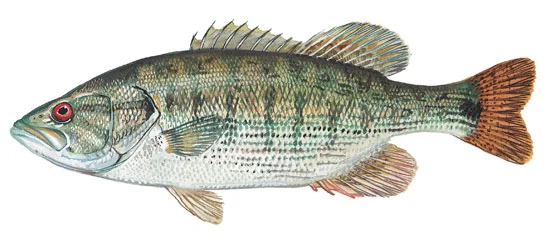
The redeye or Coosa bass is an elongate, slender fish with a large mouth that extends to or slightly behind the rear margin of the eye. The dorsal fin contains nine to 11 (usually 10) spines and 11 to 13 (usually 12) rays, and the area between the two is only slightly notched. The anal fin contains three spines and nine to 11 (usually 10) rays. The complete lateral line has from 63 to 74 scales. Scales above the lateral line number 12 or 13. A small tooth patch is present on the tongue. The back and sides are generally olive to brown with darker brown mottling. Adults have several horizontal rows of dark spots on the lower sides and venter. Breeding males have a light bluish green color on the lower head and throat. On juveniles, the sides of the body usually have 10 to 12 dark blotches that do not join to form a lateral stripe. The upper and lower margins of the caudal fin are edged in white, a useful feature for separating redeye bass from both smallmouth bass and "shoal bass".
Remarks: The type locality is Fisher Creek, Etowah County, Alabama. The redeye bass is an excellent game fish, especially when taken on ultralight spinning tackle or a fly rod.
Distribution: Endemic to the Mobile basin, redeye bass are distributed above the Fall Line in the Coosa and Tallapoosa river systems. Lack of records from sections of the Sipsey, Mulberry, and Locust forks and upper Black Warrior River could be due to habitat disruption in the Birmingham area.
Original Description: Hubbs and Bailey described the redeye bass in 1940.
Etymology: Micropterusmeans small fin.Coosaemeans Coosa River.
Habitat & Range
The redeye inhabits small to medium-sized upland streams and only rarely large rivers and impoundments. It is often found in water willow (Justicia) or other aquatic vegetation, near a submerged stump or boulder, or along an undercut bank. Juveniles occur in shallow runs and riffles over sand and gravel substrates. Spawning occurs from April to June. Etnier and Starnes (1993) note longevity of nine to 10 years. Diet includes aquatic and terrestrial insects, crayfishes, and small fishes.
Frequently Asked Questions
Black Bass — Regulations
Daily Creel Limit: 10 Notes: Includes combinations of largemouth, smallmouth, spotted, Alabama, shoal and those species formerly known as “redeye” bass, which are now known separately as Coosa, Warrior, Cahaba, Tallapoosa and Chattahoochee bass, based on their respective drainages. The Alabama bass was formerly known as spotted bass in the Mobile drainage. No more than 5 of the daily creel limit of 10 may be smallmouth bass. See exceptions for shoal bass in specific tributaries of the Chattahoochee River.
Black Bass — Regulations
Daily Creel Limit: 10 Notes: Includes combinations of largemouth, smallmouth, spotted, Alabama, shoal and those species formerly known as “redeye” bass, which are now known separately as Coosa, Warrior, Cahaba, Tallapoosa and Chattahoochee bass, based on their respective drainages. The Alabama bass was formerly known as spotted bass in the Mobile drainage. No more than 5 of the daily creel limit of 10 may be smallmouth bass. See exceptions for shoal bass in specific tributaries of the Chattahoochee River.
Size
14 to 17 inches (356 to 432 mm).
State Record
a list of theState Record Freshwater Fish.