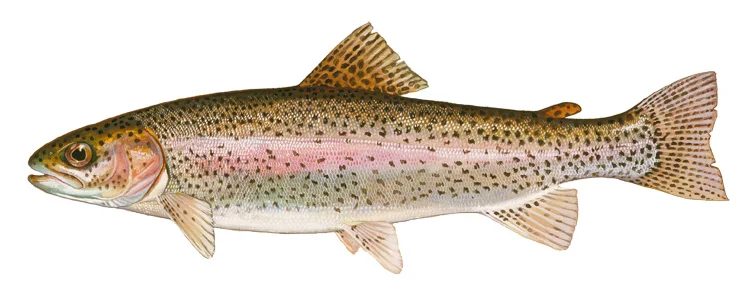
The rainbow trout has many small spots scattered across its back, sides, head, and caudal fin. The back is brassy green flecked with iridescent purple and green; the venter is white or gray. A wide pink, purple, or red band marks the sides. The body form is spindle-shaped, and the mouth is terminal and large. No fins have spines. A fleshy adipose fin is present between the caudal and dorsal fins. Scales are cycloid, very small, and embedded under a thick mucus coat. Recent adjustments in the taxonomy of salmon and trout have placed Pacific salmon and trout in the genusOncorhynchus, while the Atlantic salmon, brown trout, and their Eurasian relatives are in the genusSalmo(reviewed by Smith and Stearley, 1989). The rainbow trout was previously known asSalmo gairdneri.
Distribution: This species occurs naturally in Pacific Coast drainages from Alaska to northwestern Mexico. It has been stocked extensively worldwide, and in North America it now occurs throughout Canada, the Great Lakes region, the Appalachians, the Ozarks, and central Mexico. In Alabama, rainbow trout are stocked in spring-fed Mud Creek in Tannehill State Park, and rainbows from the Dale Hollow National Fish Hatchery in Tennessee are stocked in cold tailwaters below Lake Lewis Smith Dam. In past years, they were stocked in some spring-fed ponds of Lauderdale and Limestone counties and in Inland Lake, which drains to the Black Warrior River. A downstream waif, most likely from the Smith tailrace or Inland Lake, was recently recorded at the mouth of North River near Tuscaloosa. Rainbows are also commonly stocked in headwaters of the Little Tallapoosa and Coosa rivers in Georgia.
Original Description: Walbaum described rainbow trout in 1792.
Etymology: Oncorhynchusmeans hook snout, referring to the hooked jaw of a breeding male.Mykissmeans presumably a derivative ofmikizhaormykz,the Kamchatkan word for trout.
Habitat & Range
Rainbow trout can adapt to a variety of habitats, given proper temperature and water-quality conditions, and to flow regimes ranging from pools to calm eddies in riffles. A temperature range from 54º to 66ºF (12º to 19ºC) is optimal, and reproducing populations require a seasonal drop in temperature below 55ºF (13ºC). Rainbows feed on various organisms, including small crustaceans and juvenile insects; adults also feed on fishes. Brayton (1981) sets maturity at one year and longevity at three or four years in Virginia, while Carlander (1969) indicates that longevity is seven years. Wild populations spawn in the spring, with migrating males usually arriving at the spawning grounds before the females do.
Frequently Asked Questions
Rainbow Trout — Regulations
Daily Creel Limit: 5 Notes: It shall be unlawful to fish with more than two rods or to cull from the creel any trout caught from the Sipsey Fork from Lewis Smith Dam downstream to the confluence with the Mulberry Fork. Culling is defined as removing and releasing a trout from the creel (live well, stringer, basket, bucket, cooler or other container) whether or not it is replaced with another trout
Size
9 to 29 in (226 to 737 mm).
State Record
a list of theState Record Freshwater Fish.