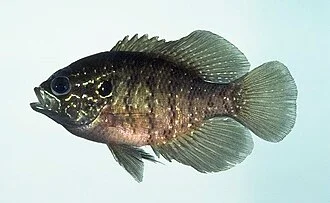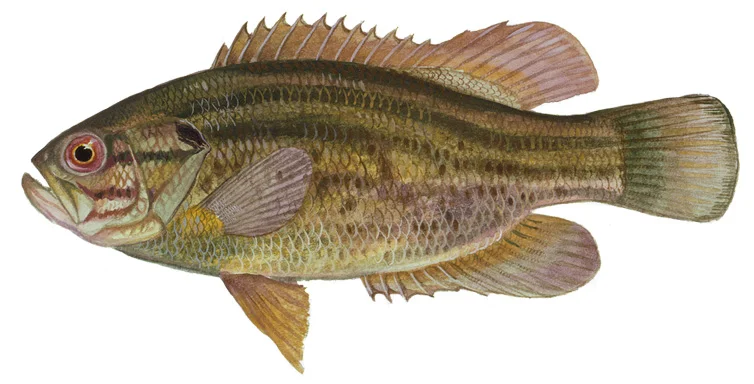
The Mud Sunfish, a small-bodied fish (maximum length 218 mm TL [8.5 in], maximum length in Alabama 125 mm TL [5.0 in], Rideret al. 2012), belongs to a monotypic genus, and is one of the 32 species of Centrarchidae. It can be identified from other sunfish as usually having 5 or more anal fin spines, less than 15 gill rakers, and the only member of Centrarchidae with cycloid scales (Rohdeet al.2009). The body of the Mud Sunfish is deep and robust with rounded pectoral and caudal fins (Jenkins and Burkhead 1994). A dark spot occurs on the operculum and body coloration ranges from brown on the dorsum to yellowish tan on the sides. The young are reported to be a pale olive in color (Jenkins and Burkhead 1994). Three to four parallel dark stripes are also present that extend from the cheek along length of the body (Rohdeet al.2009).
Remarks: The Mud Sunfish has been found in one location in Alabama. Since much of the wetlands and swamp areas have been converted to tree culture, potential habitat is limited. Recent genetic evidence suggests the Beaver Dam Creek population of Mud Sunfish may be a native and unique population (Sandel 2012). Although Mud Sunfish populations seems to be sensitive to anthropogenic threats as they are extirpated in 2 states, imperiled in 5, and apparently secure in only 3, the Beaver Dam Creek population is secure for several reasons. This population is found on private land where the landowner has a conservation acknowledgement of this unique population, public access to the location is difficult, and freshwater springs provide a constant water source year round providing a refuge during the hot summer months. Additional surveys are recommended in Washington County and surrounding areas to ascertain the distribution, abundance, and status of Mud Sunfish in Alabama, coupled with obtaining specimens from other Gulf Slope locations to determine the proper designation of the Beaver Creek Dam Mud Sunfish. Monitoring should be completed every 2-3 years.
Distribution: This species occurs in the Atlantic Coastal Plain from New Jersey to tributaries of the Gulf Coastal Plain in Georgia and Florida (Marcyet al.2005; Rohdeet al.2009). In Alabama, Mud Sunfish have only been collected from Beaver Dam Creek in Washington County, representing the most western distribution and the only known population from the Mobile River Basin (Rider and Schell 2012).
Etymology: Acantharchuscomes from the combination of akantha meaning thorn and archos meaning anus.Pomotiscomes from the old name ofLepomis, the genus of other bream.
Habitat & Range
Mud Sunfish occur in swamps and sluggish waters. Habitat characteristics are typically undercut banks and pools with bottom substrates consisting of mud, silt, and detritus associated with aquatic vegetation (Laerm and Freeman 1986; Marcyet al. 2005.) Few studies have concentrated on Mud Sunfish due to its nocturnal nature, low natural densities, and lack of sampling effort in swamps; consequently, it is the most poorly studied species of the family Centrarchidae (Mansueti and Elser 1953; Marcyet al.2005). Nevertheless, the few studies that have been conducted have revealed that spawning seems to vary with latitude as gravid females were collected late spring to early summer in Delaware and spawning in North Carolina and Georgia occurs from early fall to late winter (Laerm and Freeman 1986; Pardue 1993; Marcyet al.2005). Maximum age was estimated at 8 years based on scale examination and sexual maturity was reached by age 1 (Mansueti and Elser 1953; Pardue 1993). Mud Sunfish forage mainly on amphipods, decapods, and coleopterans followed by fish and odonates (Pardue 1993). Using modified trash cans as fish traps (Luhring and Jennison 2008), 14 more Mud Sunfish were collected from Beaver Dam Creek in Alabama (Rideret al.2012). Although Mud Sunfish were the most abundant species with this gear, their densities (0.02 fish/night) were low as observed in other systems.
Frequently Asked Questions
Bream (Sunfish) — Regulations
Daily Creel Limit: 50 Notes: —
Size
3 to 5 in (75 to 127 mm)