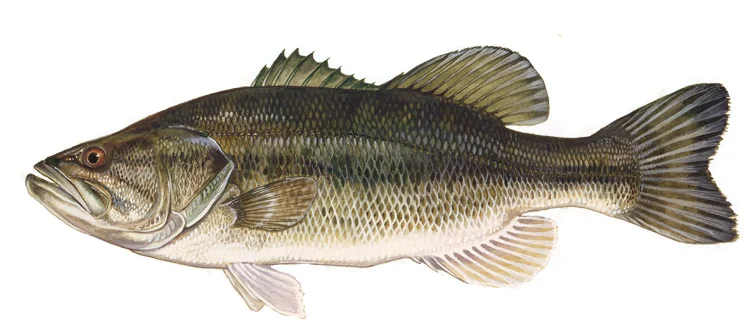
A heavy-bodied fish with 56–70 lateral line scales and a large mouth where the upper jaw typically extends past the rear eye margin. The spiny and soft dorsal fin have a deep notch between them, with 9–11 spines and 12–14 rays respectively; the anal fin bears three spines and 10–12 rays. Dorsal and anal fin bases are mostly scaleless or only slightly scaled, and the tongue is toothless. The back ranges from olive green to brown, sides are greenish with a wide black band made of oval blotches linked by shorter ones. The venter is white, and rows of scales with darkened centers between it and the lateral stripe give a striped look. Dorsal, caudal, and pectoral fins are greenish; pelvic and anal fins are clear to white.
Remarks: This species is the primary target species of most recreational and tournament bass anglers in North America.
Distribution: Native populations exist throughout the eastern U.S. Extensive stocking of the Florida subspecies (M. s. floridanus) and the mainland subspecies (M. s. salmoides) has spread the species from the Atlantic to the Pacific, and from southern Canada into Mexico. Florida-strain largemouth bass have been deliberately stocked in Alabama since 1971 and continue to be introduced by state and private fisheries biologists.
Original Description: Lacepède described the species in 1802.
Etymology: Micropterus means small fin. Salmoides derives from salmo, the name originally given to this species.
Habitat & Range
Largemouth bass inhabit nearly every aquatic environment in Alabama. They thrive in lakes, ponds and reservoirs and handle turbidity and slower currents better than other Micropterus species. Spawning happens from April through late May once water reaches 63–68°F (17–20°C). Their diet includes bluegills and redear sunfish in stocked ponds, plus shad, minnows, smaller sunfishes, crayfishes, and amphibians in natural settings. Etnier and Starnes (1993) note an average lifespan of 10–12 years in Tennessee, and Alabama Wildlife and Freshwater Fisheries Division studies show comparable ages in Alabama.
Frequently Asked Questions
Black Bass — Regulations
Daily Creel Limit: 10 Notes: Includes combinations of largemouth, smallmouth, spotted, Alabama, shoal and those species formerly known as “redeye” bass, which are now known separately as Coosa, Warrior, Cahaba, Tallapoosa and Chattahoochee bass, based on their respective drainages. The Alabama bass was formerly known as spotted bass in the Mobile drainage. No more than 5 of the daily creel limit of 10 may be smallmouth bass. See exceptions for shoal bass in specific tributaries of the Chattahoochee River.
Black Bass — Regulations
Daily Creel Limit: 10 Notes: Includes combinations of largemouth, smallmouth, spotted, Alabama, shoal and those species formerly known as “redeye” bass, which are now known separately as Coosa, Warrior, Cahaba, Tallapoosa and Chattahoochee bass, based on their respective drainages. The Alabama bass was formerly known as spotted bass in the Mobile drainage. No more than 5 of the daily creel limit of 10 may be smallmouth bass. See exceptions for shoal bass in specific tributaries of the Chattahoochee River.
Size
12 to 30 inches (300 to 762 mm)
State Record
See the State Record Freshwater Fish list on outdooralabama.com