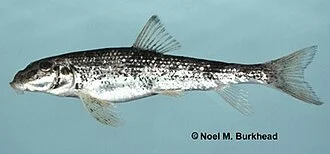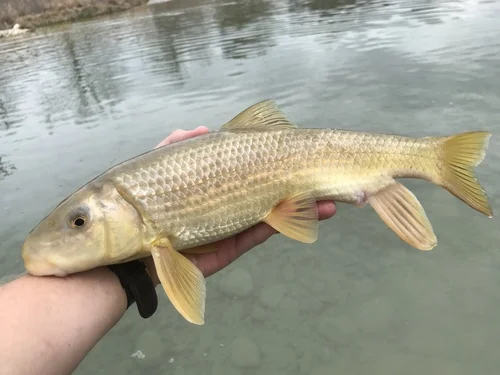
The “grayfin redhorse” has the same general body shape as the blacktail redhorse, but it lacks the distinctive black-and-white striping on the lower lobe of the caudal fin. Vertical and paired fins are gray rather than the light orange usually observed on blacktail redhorses. Live “grayfin redhorses” usually have a series of dusky stripes along the sides.
Remarks: The taxonomic status of this species is being reviewed by R. E. Jenkins.
Distribution: “Grayfin” and blacktail redhorses have allopatric (nonoverlapping) ranges in Alabama: the former is limited to the Chattahoochee River system, while the latter occurs only as far east as the Choctawhatchee River system, which lies immediately west of the Chattahoochee. Gilbert and Snelson (1992) report that dam construction has eliminated much of this species’ riverine habitat along the Alabama-Georgia state line. During our boat electrofishing surveys from 1993 through 1995, we collected and released “grayfin redhorses” in the downstream sections of several large Chattahoochee tributaries near the Alabama-Georgia line.
Etymology: Moxostomameans mouth to suck.
Habitat & Range
This species is often abundant in low-gradient streams characterized by moderate or slow currents and sand and silt substrates. Our observations indicate that spawning occurs in March and April. According to an unpublished study completed by McSwain and Pasch (1972) and reported by Gilbert and Snelson (1992), spawning occurs in moderate current over clean sand and gravel substrates from February through April. Principal food items include aquatic insect larvae, bivalve mollusks, and organic detritus. Maximum life span is around six years.
Frequently Asked Questions
Size
10 to 16 in (254 to 406 mm)