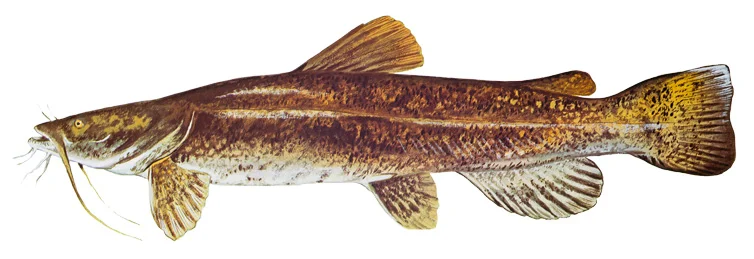
In Alabama, the flathead is the only large catfish with a head that is flattened between the eyes, a projecting lower jaw, and recurved tooth patches on either side of the upper jaw. The back and sides of the body and fins are mottled with black, white, olive, and even pale yellow, with the venter white or pale yellow. The short, rounded anal fin contains 14 to 18 rays. The caudal fin is slightly notched, and the top of the upper lobe is white on all but extremely large individuals. See Rafinesque (1818b) for original description.
Remarks: The flathead catfish is a favorite food fish in Alabama. Malvestuto et al. (1983) report that 30,924 pounds of flathead catfish were harvested in the Mobile Delta and lower Tombigbee River in 1980 and 1981.
Distribution: Pylodictis olivarisis widespread and occasionally abundant in all rivers and reservoirs of the Mobile basin. It is common in the Tennessee River and many of its major tributaries. Flathead catfish have been introduced into the Conecuh and Escatawpa rivers in southern Alabama; they are fairly common in the former drainage and rare in the latter. Future sampling will probably expand the known range of this species in Alabama.
Original Description: Rafinesque described the flathead catfish in 1818.
Etymology: Pylodictismeans mud fish.Olivarismeans olive-colored.
Habitat & Range
We most frequently capture flathead catfish in flowing water over sand, gravel, and mud substrates. Individuals are usually associated with underwater structures such as fallen trees, stumps, rock ledges, and riprap. Flatheads are aggressive predators and opportunistic feeders. Young feed on aquatic insect larvae, crayfish, and small minnows. Adults eat crayfish and live or dead fish. Spawning over excavated pits occurs in June and July in Alabama and Tennessee (Etnier and Starnes, 1993). Young flatheads school, but they soon separate and become solitary after reaching lengths of several inches. Etnier and Starnes (1993) report a life span of 19 years.
Frequently Asked Questions
Catfish — Regulations
Daily Creel Limit: 1 Size Limit: This size limit shall not apply to catfish harvested from the Perdido, Conecuh, Blackwater, Yellow, Choctawhatchee, Chipola, and Chattahoochee rivers basins. It shall be unlawful to transport live catfish 34 inches in length or greater beyond the boundaries of this State. Notes: —
Size
18 to 24 in (460 to 610 mm). We have collected flatheads in the 30- to 50-pound class from the Tennessee River drainage south to the Alabama River and also in the tail-waters of several locks and dams.
State Record
a list of theState Record Freshwater Fish.