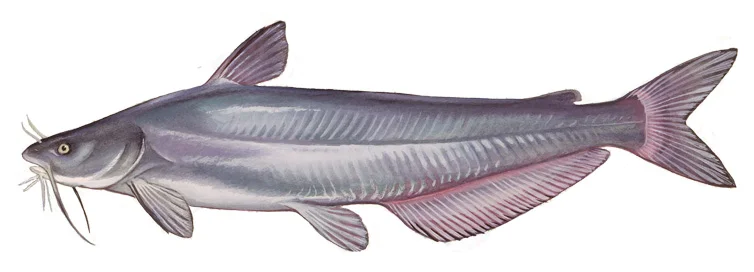
This pale blue catfish has a deeply forked tail and white chin barbels. The upper and lower jaws meet evenly, or the upper jaw may project slightly beyond the lower jaw. Distinguishing small blue catfish and channel catfish,Ictalurus punctatus,can be difficult, but the two species can usually be separated by anal fin shape and size. The anal fin on the blue catfish has 30 or more soft rays, and its free margin is straight. The anal fin on the channel catfish has 24 to 29 soft rays, and its free margin is rounded. In body color, the blue catfish is light blue, while the channel catfish is light yellow with small, scattered dark spots. See Cuvier and Valenciennes (1840) for the original description of blue catfish.
Remarks: Blue catfish are delicious, and they are therefore a target species for many sport and commercial fishermen. Malvestuto et al. (1983) report that anglers and commercial fishermen harvested approximately 250,000 pounds of blue catfish from the Mobile Delta and lower Tombigbee River in 1980 and 1981.
Distribution: Blue catfish are widespread and occasionally abundant in the Mobile basin and Tennessee River. The appearance of a limited range above the Fall Line could be due to insufficient and improperly equipped sampling of large streams and rivers. Glodek (1979c) does not include the Conecuh River within the native range of this species, but our surveys confirmed its presence at five localities in the drainage. Blue catfish were accidentally introduced into the Choctawhatchee River in 1993, when heavy rains broke the dam of a private lake stocked with numerous brood fish. Most were caught by local anglers, but a few may persist in the area.
Original Description: Lesueur described the blue catfish in 1840.
Etymology: Ictalurusmeans fish cat.Furcatusmeans forked, referring to this species’ deeply forked caudal fin.
Habitat & Range
Blue catfish prefer riverine and resevoir habitats. The largest individuals we have encountered were in tailwaters below dams, where currents were swift and substrates consisted of sand, gravel, and rock. Blue and flathead catfish also congregate around submerged treetops. Like many other species in the family, blue catfish are opportunistic feeders, consuming live and dead fish and benthic invertebrates.
Frequently Asked Questions
Catfish — Regulations
Daily Creel Limit: 1 Size Limit: This size limit shall not apply to catfish harvested from the Perdido, Conecuh, Blackwater, Yellow, Choctawhatchee, Chipola, and Chattahoochee rivers basins. It shall be unlawful to transport live catfish 34 inches in length or greater beyond the boundaries of this State. Notes: —
Size
18 to 24 in (460 to 610 mm). During our river surveys, we infrequently collect and release blue catfish weighing 30 to 50 pounds; most specimens are 10 pounds or less.
State Record
a list of theState Record Freshwater Fish.