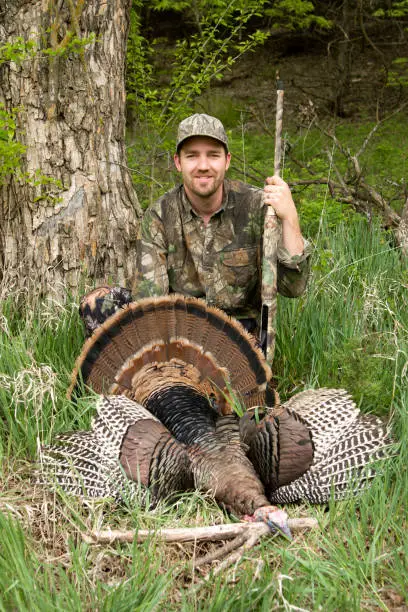
Spring turkey hunting is a sport built on observation, patience, and the willingness to adapt. Whether you're threading through ponderosa pines in pursuit of Merriam's turkeys, or crouching in the palmetto hammocks of South Florida hoping for a glimpse of the elusive Osceola, the challenges share more in common than you might expect. Henned-up birds, unpredictable morning fog, thick cover, and silent toms test every hunter's ability to read the situation and respond intelligently.
Understanding the Challenge: The Henned-Up Gobbler
The single most common obstacle every spring turkey hunter faces is the henned-up gobbler. When season opens and birds are still grouped in large flocks — toms traveling alongside multiple hens — calling a gobbler away from his natural companions is one of the most difficult things to accomplish in upland bird hunting.
Early in the season, this is simply the reality on the ground. Gobblers are visible, they're gobbling, and they're responding to calls — but they rarely commit. They answer from a distance, hold at 80 or 100 yards, and then drift back toward the flock. Many hunters mistake this as failure and move on. The better read is that the birds aren't ready yet, and the morning still has time to change.
The most effective mindset in these conditions is straightforward: get close, hunt all day, and wait for the right moment. Henned-up gobblers eventually separate. Hens go to nest as the morning matures, satellite toms get pushed out by dominant birds, and flocks naturally splinter. The hunter who is already inside that bubble — within 100 to 125 yards of the birds — is positioned to capitalize when the dynamic shifts.
Tactic One: Terrain-Driven Stalking to Close the Gap
One of the most underused strategies in turkey hunting is aggressive terrain-driven movement — using the landscape itself to compress distance rather than relying on calling to pull birds across long stretches of ground.
The goal is to get on the same ridge as the flock and work above them. Sound travels more naturally downhill, making your calling more effective. Birds approaching from below are walking uphill — a slower, more deliberate movement that gives you more time to prepare for a shot. Getting laterally across a canyon, by contrast, puts topography and line-of-sight working against you.
When a gobbler approaches, holds up, and eventually retreats without committing, don't panic and don't relocate. Hold your position. There is a real chance those birds will circle back. Patience in that moment is more powerful than any call you could make.
Key Lesson: Closing physical distance replaces the advantage of a calling partner. Getting inside the birds' comfort zone makes a short approach feel natural rather than suspicious. Move slowly, use terrain, and let the land do the work.
Tactic Two: The Roost Hunt — Knowing Where Birds Sleep
The single most reliable way to put yourself in position on opening morning is to locate birds the evening before. A roost hunt begins the afternoon prior — walking quietly, listening for gobbles as the light drops, and marking the trees where birds are flying up for the night.
With that information in hand, the morning hunt transforms from a guessing game into a precision setup. Return to the area well before shooting light and get established within range of the roost before the birds begin to stir. Setting up 70 yards from the roost trees gives you close proximity without crowding the birds.
Roosting birds also gives you critical intelligence about travel corridors. Where birds roost in relation to where you saw them feeding the afternoon before tells you which direction they'll move after flydown. Setting up between the roost and that destination puts you in the path of natural movement.
Key Lesson: Spend time in the field the afternoon before your hunt. Listen at dusk. Follow the gobbles. A roost located is a morning well-planned.
Tactic Three: Decoy Placement in Open Country
Not every setup comes with the luxury of cover. Some of the most productive turkey habitat — open timber, wide creek bottoms, flat prairie — offers almost no concealment. This is precisely the situation where a decoy earns its place.
When gobblers are grouped with hens and need to cross open ground to reach a call, a visual target can be the difference between a bird that hangs up at 80 yards and one that commits fully. A jake decoy — representing a subordinate male — can be especially effective. Gobblers with dominant status will often challenge a jake decoy aggressively, approaching without hesitation, triggering a competitive instinct that overrides caution.
Key Lesson: Match your tools to your terrain. Dense cover calls for patience and proximity. Open ground rewards a well-placed decoy that gives arriving birds something to commit to visually.
Hunting the Osceola: Learning to Hunt in Silence
The Osceola turkey — found only in the southern half of Florida — lives in a world of slash pine flatwoods, palmetto thickets, and open marshy prairies. It is dense, tangled, and humid. Unlike western terrain where you can glass from elevation, the Florida swamp offers no such vantage point. Shot opportunities come at 10 to 20 yards. Birds materialize silently from the brush.
The most critical mental adjustment for hunting the Osceola is letting go of the expectation that gobblers will announce their approach. In Florida's thick cover, a bird going quiet on his final approach is completely normal. He has heard the call, he is committed, and he is navigating toward you without wasting energy on sound. Hunters who interpret that silence as failure and stand up to relocate will walk right into the bird they were about to shoot.
Key Lesson: Adjust your expectations to match the subspecies and the conditions. A quiet morning in thick Florida cover is not a failed morning — it may be exactly the right morning to sit still and call patiently.
The Midmorning Opportunity: Why You Should Stay
Across varied turkey hunting scenarios, one of the most consistent and overlooked opportunities comes not at first light — but in the late morning, after most hunters have already headed home.
As the morning progresses, hens begin to leave the flock to attend to nesting duties. Satellite toms — those lower-ranked birds that have been tolerated at the edges of the flock — suddenly find themselves without the social structure they've been embedded in all morning. At that point, a soft call from a nearby location can be irresistible. This midmorning dynamic has produced some of the most memorable turkey hunts in the spring woods.
Key Lesson: When early-morning birds won't cooperate, patience is your most effective tactic. Hunt through the full morning. The window that opens after hens peel off toward nesting is often the most productive of the entire day.
Final Reflection: Adaptability as the Core Skill
What unites every successful turkey hunt across every landscape is adaptability. No single tactic works everywhere or in every set of conditions. Close the distance when birds won't commit to calling from afar. Roost birds the evening before to stack the morning's odds in your favor. Deploy a decoy when open country demands a visual anchor. Stay patient when silence fills the swamp. Hang through the midmorning when early flocks keep gobblers preoccupied.
The hunter who can assess which situation they're in — and switch strategies accordingly — is the hunter who consistently fills tags across seasons, landscapes, and subspecies. That flexibility is not innate. It's built, one morning at a time, in the spring woods.