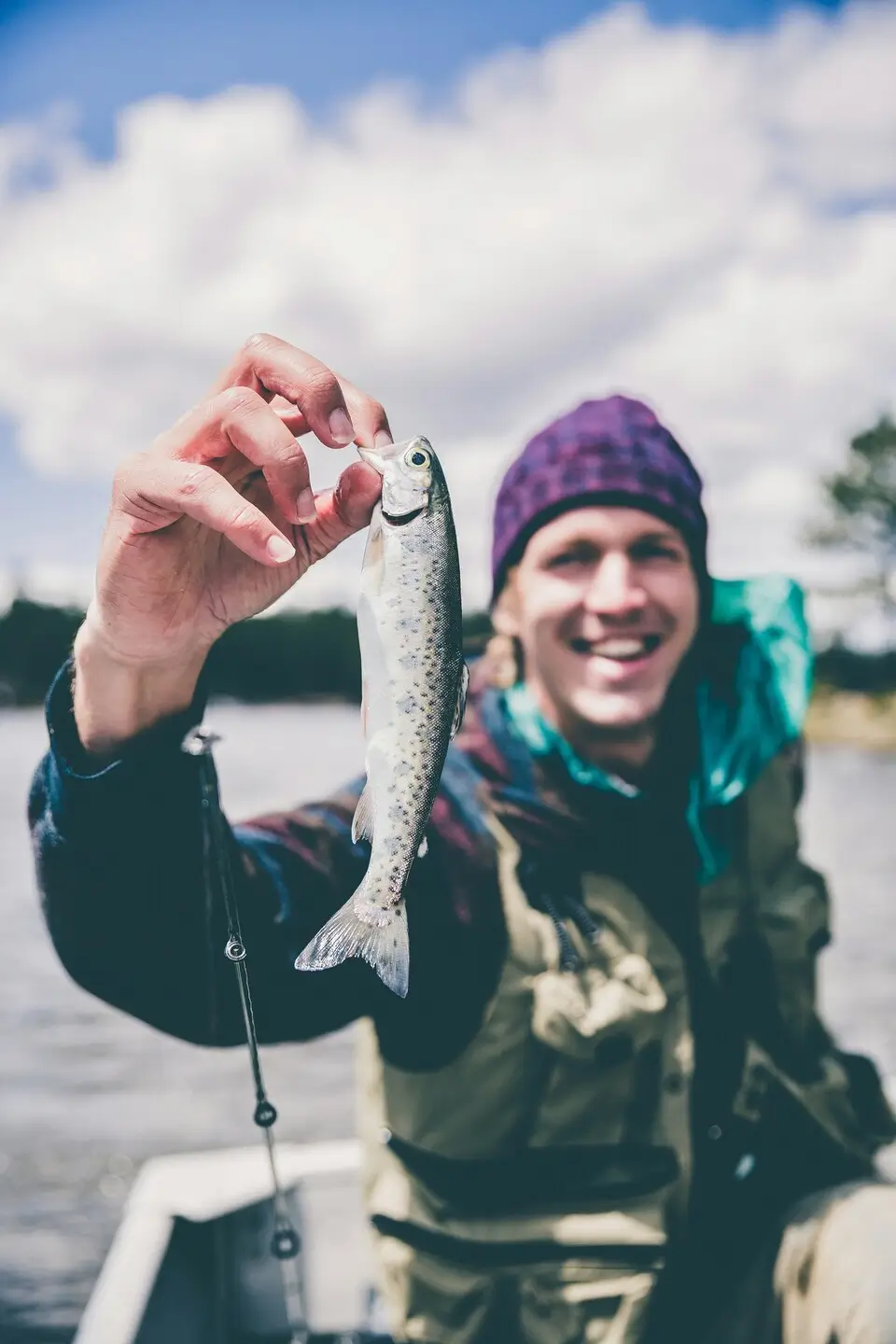
Some lessons in fishing can be read in a guide. Others only arrive through repetition — a knot that fails at the worst moment, a slow afternoon that suddenly erupts when you change nothing but your retrieve speed, a day when the familiar spot yields nothing and moving thirty yards makes all the difference. The tips gathered here reflect patterns that experienced anglers encounter repeatedly, distilled into the principles most worth internalizing early.
Master One Knot — Then Make It Second Nature
Of all the practical skills in fishing, knot tying is the one most consistently identified as the dividing line between beginners who struggle and those who start catching consistently. The hesitation to retie — because it's fiddly, because the light is bad, because it takes time — causes more lost fish and lost lures than almost any other single factor.
The solution isn't to learn a dozen knots. It's to learn one well enough to tie it confidently in poor light, with cold hands, without looking. The Palomar knot is widely favored for its simplicity and reliability across monofilament, fluorocarbon, and braided lines. The Uni knot offers more versatility — it works for attaching hooks, joining two lines, and connecting a leader to main line. Either is sufficient for the vast majority of freshwater and inshore fishing situations.
Key Insight: A knot you can tie automatically will get retied regularly. A knot you have to think through will be skipped — and that's when lines fail under pressure. Practice at home until the motion is entirely muscle memory, then check the knot at the start of every session and after every significant fish.
Gear Cannot Substitute for Skill — and Usually Doesn't Help
There is a version of fishing equipment that exists primarily to appeal to anglers, not to catch fish. The tackle market is sophisticated and genuinely good at creating desire for new gear. Experienced anglers across decades of fishing return again and again to a simple observation: the lures, rigs, and setups they actually rely on are almost always simple, often inexpensive, and frequently the same ones they've used for years.
What changes their catch rate is not the cost of their lure. It's where they place it, how they present it, and what conditions they're reading when they make that choice. A modest rod fished with knowledge of the water will outperform expensive gear cast blindly into empty water on every occasion.
This doesn't mean gear quality is irrelevant. A rod that's appropriately matched to the technique — weight, action, sensitivity — makes a real difference over a long day. But that's a different conversation from believing a more expensive lure will attract more fish. It won't. The fish don't see the price tag.
Pro Tip: Before buying any new lure, ask whether your issue is presentation, location, or timing. In most slow sessions, the answer is one of those three — and none of them require a purchase to fix.
Slow Everything Down — Especially Your Retrieve
The single most repeated technical adjustment among experienced anglers is this: slow down. Beginners tend to retrieve lures too fast, move between spots too quickly, and cast too frenetically. Each of these habits reduces catch rates in ways that are invisible in the moment.
A slower retrieve gives fish more time to track, commit to, and strike a lure. In cold water, fish metabolism slows and they are rarely willing to chase a fast-moving bait. In heavily pressured water, a lure moving quickly through a spot is exactly what fish have learned to ignore. Slowing to half your natural instinct — then slowing further — is almost always the right adjustment when bites stop coming.
The same principle applies to changing spots. Moving too soon abandons water that may simply be between feeding windows. Give a productive area sufficient time before writing it off. When a spot is genuinely producing, stay — don't leave fish to find fish.
Key Insight: If you're fishing what feels like a slow retrieve, try pausing entirely for two to three seconds mid-retrieve. Many strikes happen on the pause, when a lure drops or suspends. That moment of stillness often triggers fish that have been following but not committing.
Lure Discipline: Cover Three Zones, Then Stop Buying
One of the more counterintuitive lessons experienced anglers share is that having too much tackle makes you less effective, not more. When a session is slow, the temptation is to cycle through lures constantly — a few casts on one, switch, a few more, switch again — never building real familiarity with how any particular lure moves and behaves. The result is a collection of lures you don't know how to fish.
A more productive approach is to cover the water column deliberately with a small, committed selection: a few topwater or surface presentations, a few mid-column options, and a few bottom-oriented presentations, each in two or three colors. Learn to fish those thoroughly across conditions, seasons, and water types. The depth and versatility of knowledge you build around a small lure selection will consistently outperform a large but shallow collection.
Poppers, buzzbaits, frogs. Most effective in low light — early morning and dusk. Work slowly and deliberately with pauses.
Swimbaits, spoons, inline spinners. Steady retrieve with speed variation. Cover water efficiently. Works when fish are actively feeding.
Texas rigs, jigs, soft plastics. Slower, more deliberate. Requires patience and sensitivity. Accounts for a large proportion of overall catch.
Color selection matters less than presentation but still matters — a general rule is darker or more contrast-rich colors in low-visibility or murky water and more natural, translucent colors in clear water. But local conditions and species behavior will always be more instructive than any universal rule.
Pro Tip: When you're in a tackle shop and not sure which color to choose, pay attention to which colors have the emptiest pegs. Local anglers are already buying what works locally — those gaps in the display are empirical evidence worth noting.
Read the Landscape Around the Water, Not Just the Water
Fish reveal their location through the behavior of the ecosystem around them. Wildlife that depends on the same food chain offers some of the most reliable signals available to a shore angler with no sonar or depth finder.
Wading birds are highly efficient hunters that spend their lives locating fish. Where they're standing still and hunting is almost always productive water.
Consistently present in areas where baitfish and other small prey concentrate. Their preferred hunting zones overlap strongly with predator fish habitat.
Baitfish breaking the surface, rings from rising fish, or swirls near cover all indicate active feeding. Work these areas immediately and quietly.
Hatching insects trigger surface feeding in many species. Matching the size and profile of what's hatching — "matching the hatch" — is often more important than lure brand or color.
Also pay attention to structure near the bank before casting out into open water. Fish — especially bass and pike — often hold very close to shore in shaded areas, near submerged roots, under docks, or along weed edges. Many anglers walk directly to the water and immediately cast as far as possible, inadvertently spooking fish that were within easy reach.
Key Insight: If you can see a fish clearly, that fish can almost certainly see you. Approach shallow, clear water low and slowly. Long-distance observation before you fish a new spot will often reveal exactly where fish are holding — and save you the cast that would have put them down.
Expect Every Day to Be Different — Even at the Same Spot
One of the more disorienting experiences in fishing is returning to a spot where fish were abundant one day and finding nothing there three days later, with apparently identical conditions. This is not a malfunction of fishing. It is one of its defining characteristics.
Fish respond to variables that are difficult or impossible to observe directly: barometric pressure changes, subtle water temperature shifts, changes in the availability of their preferred prey, tidal and lunar cycles in coastal environments, and the cumulative effect of fishing pressure from other anglers. A spot that produced thirty fish on Monday may yield none on Thursday — not because you're doing anything wrong, but because the fish aren't there anymore, or aren't feeding.
The appropriate response is to adapt rather than persist with the same approach. Change your depth, your retrieve cadence, your lure color, or your location entirely. The ability to read why a spot isn't producing and adjust accordingly is what separates consistently successful anglers from those who have good days and bad days for reasons they can't identify.
Keep a Fishing Log — Patterns Emerge Faster Than You Think
One of the more practical habits experienced anglers recommend is maintaining a simple record of each session: the date, location, time, weather conditions, water temperature and clarity if known, what presentations were used, and what produced results. It doesn't need to be elaborate. Even a brief notes-app entry after each trip accumulates into something genuinely useful within a single season.
Patterns that are invisible trip-by-trip become clear over a season of records. The same spot may consistently produce only at a specific tidal stage or in overcast conditions. A particular lure color may show up repeatedly in the successful entries during certain months. Water temperature thresholds for different species' feeding behavior become apparent. None of this is accessible from memory alone — memory tends to flatten and distort. Written records don't.
Pro Tip: Note not just what worked but what you tried that didn't work. Understanding why certain presentations failed in certain conditions is as instructive as knowing what produced — and prevents you from repeating unsuccessful approaches when conditions repeat.
Sun Protection Is Not Optional on the Water
Water reflects UV radiation significantly, intensifying sun exposure beyond what the air temperature or cloud cover might suggest. Extended sessions on open water — particularly in a boat where there is no shade and little opportunity to move into cover — can produce serious sunburn in a fraction of the time it would take on land, even on overcast days.
The practical implications are straightforward. Apply broad-spectrum sunscreen before leaving, reapply every two hours regardless of whether you feel like you need to, and consider UV-protective clothing for any session longer than a few hours. Polarized sunglasses serve a dual purpose: they reduce UV exposure to the eyes and reduce water glare enough to reveal structure, fish, and depth changes that would otherwise be invisible.
Apply sunscreen before you arrive at the water — not after you've set up. The first hours of sun exposure are often the most intense.
Reapply every two hours and after contact with water. A single application at dawn provides no meaningful protection by midday.
Wear polarized sunglasses. They protect your eyes and allow you to see into the water — two benefits in one piece of equipment.
Stay hydrated. Time on the water passes quickly and the combination of sun, physical activity, and cool air near the water can mask dehydration until it's significant.
The Right Mindset Makes Everything Else Work
There is a behavioral dimension to fishing that experienced anglers describe repeatedly: frustration actively reduces catch rates. Fishing while impatient or tense tends to produce faster retrieves, less careful presentations, less observant scanning of the water, and an impulse to switch lures or spots before either has been given adequate time. All of these degrade the outcome.
The corrective is not a performance technique — it's a genuine shift in how you define a successful day on the water. If catching fish is the only measure of success, slow days become failures. If being outside, observing a system you're learning to understand, and practicing skills that improve gradually over time counts as success, then slow days still give you something. Most experienced anglers describe this not as a consolation but as something they actually believe, arrived at through enough time on the water to know that the process is inseparable from the reward.
When frustration does rise during a slow session, a practical response is to stop fishing for fifteen or twenty minutes and simply watch — the surface, the banks, the wildlife, the current patterns. That observation window almost always reveals something useful about where fish might be and what they might be doing, and it resets the mental state that was degrading the fishing anyway.